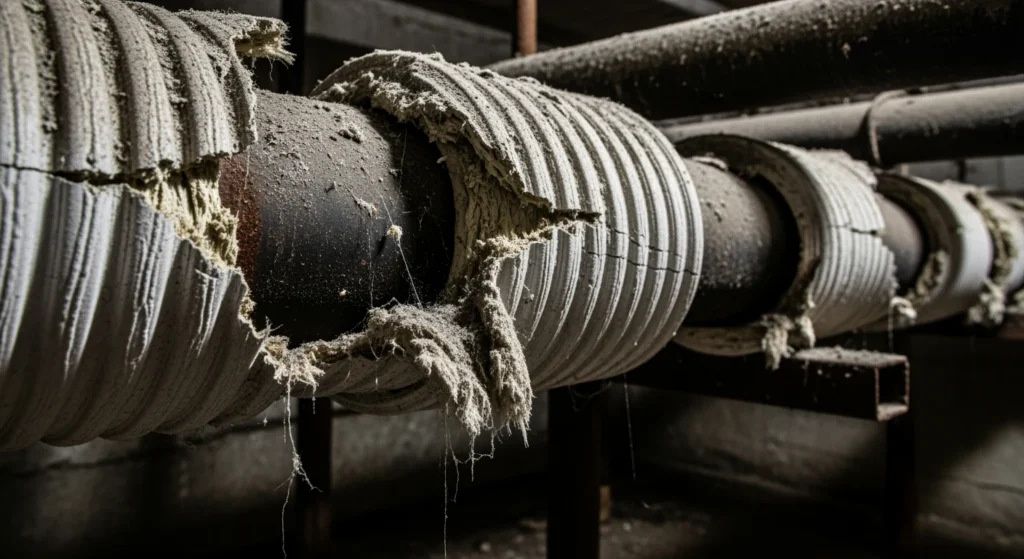
Asbestos pipe insulation is the single most common asbestos-containing material in Long Island commercial buildings. Installed on hot water, steam, and HVAC piping throughout mechanical rooms, ceiling plenums, and utility chases, this friable material presents the highest exposure risk to maintenance workers and building occupants when it deteriorates or is disturbed.
Where Asbestos Pipe Insulation Is Found in Commercial Buildings
Long Island commercial buildings constructed between 1940 and 1980 used asbestos pipe insulation extensively. The most common locations include boiler rooms and mechanical spaces where primary heating and cooling distribution lines are insulated, above-ceiling plenums throughout office floors where branch piping runs to individual zones, utility tunnels and chases connecting building wings, and basement-level distribution piping in multi-story commercial structures across Nassau and Suffolk Counties.
Asbestos pipe insulation takes several forms: corrugated air-cell wrap (the most recognizable type), smooth hard-set calcium silicate covering, and paper-backed blanket wrap. All three forms contain between 15% and 100% chrysotile or amosite asbestos by weight.
The Removal Process for Commercial Properties
Glove bag method is used for isolated sections of pipe insulation — typically individual fittings, valves, or short straight runs. A sealed polyethylene bag is placed around the pipe section, the insulation is wetted and removed inside the bag, and the bag is sealed as waste. This method is efficient for limited quantities and avoids full-room containment.
Full containment method is required for large-scale pipe insulation removal — entire mechanical rooms, long runs, or multiple areas. The work area is sealed with polyethylene sheeting, negative air pressure is established using HEPA-filtered air machines, workers in full personal protective equipment remove wetted insulation, and continuous air monitoring verifies fiber levels remain below OSHA permissible exposure limits.
Both methods require: NYS DOL project notification (10 days advance), licensed abatement contractor and workers, NYS DOH-certified project monitor for air sampling, wet removal methods to minimize fiber release, double-bagged waste in labeled asbestos disposal bags, and final clearance air testing before containment is removed.
Cost Breakdown for Long Island Commercial Projects
Pipe insulation removal costs depend on linear footage, accessibility, and containment method. For Long Island commercial properties, expect $10 to $25 per linear foot for standard removal. A typical commercial boiler room with 300 linear feet of insulated piping runs $6,000 to $12,000 complete. Above-ceiling work with restricted access and the need for scaffold or lift equipment adds 25-40% to baseline costs. Emergency removal following pipe breaks or water damage carries premium pricing due to expedited mobilization.
Encapsulation as an Alternative
When pipe insulation is intact, in good condition, and the piping system will not be modified, encapsulation offers a lower-cost alternative. A bridging encapsulant creates a protective membrane over the insulation surface, preventing fiber release. Cost runs $3 to $8 per linear foot — significantly less than removal. However, encapsulation requires ongoing monitoring, does not eliminate the material, and may need to be removed eventually if building renovations require access to the piping.
Upper Restoration’s Commercial Pipe Insulation Services
Upper Restoration performs both glove bag and full containment asbestos pipe insulation removal across Long Island commercial properties. Our licensed abatement crews work in occupied buildings with minimal disruption, handle NYS DOL notification and compliance documentation, and coordinate with third-party air monitoring firms to deliver clearance on schedule. Serving Nassau and Suffolk Counties for all commercial asbestos pipe insulation abatement needs.