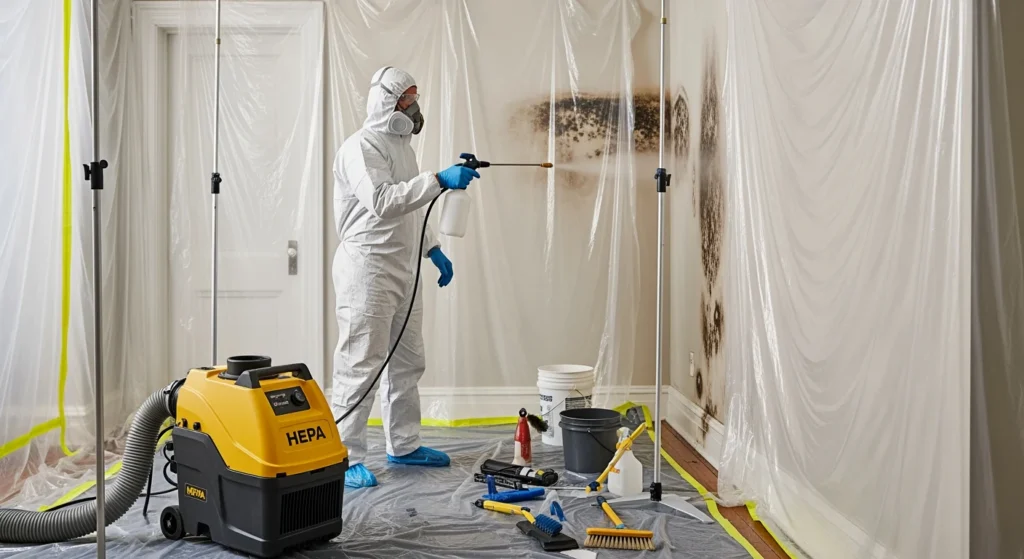
If you have noticed faint dark lines appearing on your walls near picture frames, along ceiling edges, or around HVAC vents in your New York City apartment, you are likely looking at candle ghosting. It is one of the most common — and most misunderstood — indoor air quality issues in city apartments, and it causes unnecessary alarm when residents mistake it for fire or smoke damage.
Candle ghosting occurs when the soot produced by burning candles circulates through the air and deposits on surfaces where temperature differentials exist. In NYC apartments, this means the outlines of wall studs (which conduct cold from exterior walls), the edges of ceiling tiles, and areas around air returns where airflow concentrates particulates. The effect is subtle — faint dark lines that look like the ghosts of the building’s framing are showing through the paint.
Understanding the difference between candle soot and fire soot matters for both health and insurance purposes. 247 Restoration Specialists’ technical breakdown of candle soot versus fire soot explains the chemical and visual distinctions — candle soot is typically fine, oily, and accumulates gradually, while fire soot is coarser, heavier, and accompanied by obvious signs of combustion like scorching, odor, and structural damage.
In New York City apartments, candle ghosting is more prevalent than most people realize. The factors are specific to urban living: smaller spaces with less air volume, windows that stay closed for much of the year, radiator heating that creates strong thermal gradients on exterior walls, and the popularity of scented candles as a way to manage the sensory experience of city living.
The insurance dimension is where misidentification becomes expensive. A tenant or co-op owner who files a fire damage claim based on what turns out to be candle soot ghosting can face claim denial and increased premiums. Conversely, actual fire or smoke damage that gets dismissed as “just candles” can leave a building with unaddressed contamination. Getting the diagnosis right at the start saves time, money, and arguments with adjusters.
For NYC apartment residents dealing with candle ghosting, the remediation is relatively straightforward. The soot deposits can be cleaned from most surfaces with a dry chemical sponge (the type used by restoration professionals) followed by repainting with a stain-blocking primer. The underlying cause — candle use in a small, sealed space — needs to be addressed to prevent recurrence. Trimming wicks, using higher-quality candles with cleaner burns, and improving ventilation all reduce soot production.
When the situation is more serious — heavy black deposits, persistent smoky odor, or staining that appeared after a specific event — professional assessment is warranted. A restoration specialist can test the soot composition and determine whether it originated from candles, cooking, an HVAC malfunction, or an actual fire event. That determination drives the remediation approach and any insurance documentation.
For NYC and Long Island residents, the rule of thumb is simple: gradual, light deposits that follow architectural lines are almost certainly candle ghosting. Sudden, heavy soot accumulation with an identifiable odor is something that deserves professional investigation. Knowing the difference protects your health, your property, and your insurance standing.