Biohazard cleanup is the restoration service that no one plans for and everyone is unprepared to navigate when they need it. A traumatic death in a family home, an unattended death discovered days or weeks after the event, a hoarding situation that has progressed to a biological hazard, or an infectious disease exposure that requires documented decontamination — these events are among the most emotionally overwhelming and technically complex scenarios in the entire restoration spectrum. They require a contractor who can operate effectively at the intersection of human crisis, regulatory compliance, and technical execution. On Long Island, they require a contractor who understands the specific legal, logistical, and community context of 1.5 million people living in close proximity across Nassau and Suffolk Counties.
This guide is the county-level authority document for biohazard cleanup across Long Island’s 13 townships. It covers the categories of biohazard remediation, the regulatory framework governing biohazard waste disposal in New York State, the technical protocols that distinguish professional biohazard cleanup from standard cleaning, the insurance landscape for these losses, and the service response framework across Nassau and Suffolk.
Categories of Biohazard Cleanup on Long Island
Trauma Scene and Crime Scene Cleanup
Trauma scene cleanup involves the remediation of biological contamination following accidental injury, violence, or suicide. The scope ranges from small-volume blood cleanup in a single room to extensive multi-surface contamination requiring full room-gut demolition. On Long Island, trauma scene cleanup is requested by families, property owners, landlords, and property managers across Nassau and Suffolk — after police have completed their investigation and released the scene but before any professional cleaning has occurred. Law enforcement does not clean trauma scenes; that responsibility falls to the property owner or, in many cases, to a family member who does not have access to the technical resources or emotional distance to manage the process.
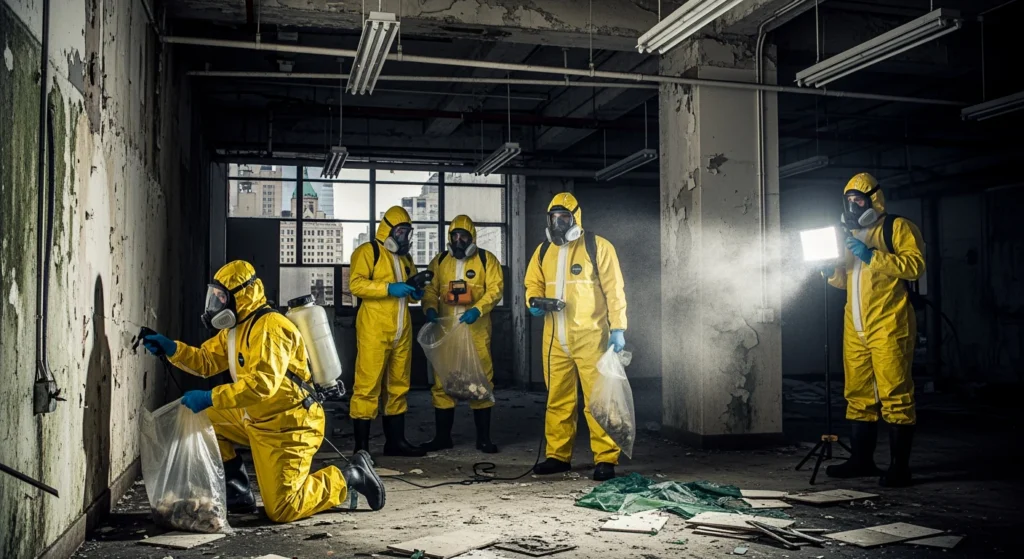
The technical requirements of trauma scene cleanup are defined by OSHA’s Bloodborne Pathogen Standard (29 CFR 1910.1030), which requires that workers with occupational exposure to blood and other potentially infectious materials (OPIM) follow Universal Precautions — treating all blood and OPIM as potentially infectious regardless of source. Every trauma scene cleanup team member must be trained in Bloodborne Pathogen procedures, wear PPE including gloves, eye protection, face shield, and appropriate respiratory protection, and follow documented decontamination procedures for all tools and equipment. Biohazardous waste generated during cleanup must be segregated, containerized in red biohazard bags or sharps containers, labeled, and transported to a licensed medical waste disposal facility — not placed in regular trash.
Unattended Death Cleanup
Unattended death — also called undiscovered death — occurs when a person dies and is not found for days, weeks, or longer. Long Island’s demographic context makes this scenario relevant: Nassau and Suffolk Counties have among the highest proportions of elderly residents living alone in the northeastern United States. The island’s aging population — Baby Boomers who populated Long Island’s post-war Cape Cods in the 1950s and 1960s are now in their 70s, 80s, and 90s — creates a structural pattern of unattended death risk in Nassau County’s older residential communities.
Unattended death creates the most severe biohazard conditions in the residential cleanup spectrum. Human decomposition releases biological fluids, gases, and cellular material that penetrate porous building materials — carpet, subfloor, drywall, and in extreme cases, wood framing — requiring demolition and removal rather than surface cleaning. The decomposition fluid that penetrates a carpeted floor in a Long Island Cape Cod must be traced through the carpet, the padding, the subfloor, and in some cases the framing below to ensure complete decontamination. Odor — the byproduct of putrefaction — requires industrial odor neutralization beyond what consumer products or standard commercial cleaning can address. Upper Restoration uses hydroxyl generation, thermal fogging, and ozone treatment in sequence to address unattended death odor in Long Island residential properties, with the specific method chosen based on occupancy status and material type.
Hoarding Remediation
Hoarding remediation is the most operationally complex biohazard cleanup category on Long Island because it combines the physical challenge of clearing extreme accumulations of material with the biological hazard of animal waste, food decomposition, and in severe cases, vermin infestation and structural compromise. Long Island’s dense suburban housing stock creates specific hoarding challenges: Cape Cods with limited storage and adjacent neighbors who are aware of and affected by the condition, condominium and co-op buildings where hoarding in one unit affects adjacent units through shared systems, and elderly homeowners in Nassau County’s older communities who have accumulated material over decades without family awareness.
Hoarding remediation on Long Island requires coordination with multiple parties beyond the property owner: family members who may have legal authority, town code enforcement officials who may have issued violations, and in some cases, the county Adult Protective Services system for elderly residents who require intervention beyond the physical cleanup. Nassau County and Suffolk County each have Adult Protective Services programs that interface with restoration contractors in hoarding cases involving elderly or vulnerable adults.
Infectious Disease Decontamination
Infectious disease decontamination became a prominent restoration service category during and after the COVID-19 pandemic, but the need predates and extends beyond any single pathogen. MRSA contamination in healthcare-adjacent facilities, C. diff in care settings, and pathogen exposure events in any occupied space can require documented, professional decontamination that goes beyond the reach of facility maintenance staff. On Long Island, healthcare facilities, schools, transportation environments, and residential properties all have legitimate needs for infectious disease decontamination services that follow documented protocols and produce clearance documentation.
The EPA maintains a list of registered disinfectants for use against specific pathogens. Professional infectious disease decontamination on Long Island uses EPA-registered products applied at label concentrations with documented dwell times, by workers with appropriate training and PPE, with post-decontamination verification testing where applicable. The documentation produced by professional decontamination — agent used, concentration, dwell time, treated surfaces, and clearance testing results — is what distinguishes professional remediation from commercial cleaning for insurance, liability, and regulatory purposes.
Regulatory Framework for Biohazard Cleanup in New York State
New York State regulates biohazard cleanup through two primary frameworks: OSHA’s Bloodborne Pathogen Standard for worker protection, and NYS DEC regulations for medical and biohazardous waste disposal.
Medical waste generated during biohazard cleanup — blood-saturated materials, sharps, and items contaminated with potentially infectious biological material — is regulated as medical waste under NYS DEC 6 NYCRR Part 364 and must be transported by a licensed medical waste transporter to a licensed treatment and disposal facility. Upper Restoration maintains current NYS DEC medical waste transporter licensing and uses licensed disposal facilities for all biohazardous waste generated during Long Island cleanup projects. The documentation trail — waste manifests, transporter certifications, disposal facility receipts — is provided to the property owner as part of the project closeout documentation.
There is no NYS-specific licensing requirement for biohazard cleanup contractors beyond the OSHA and DEC waste disposal requirements — unlike mold remediation (Article 32) and asbestos abatement (Code Rule 56), biohazard cleanup does not have a contractor-specific license in New York. This creates a contractor quality gap: any cleaning company can legally perform biohazard cleanup, but the technical requirements of OSHA BBP compliance, proper waste classification and disposal, and comprehensive decontamination verification are not met by general cleaning services. Verify that any biohazard contractor used on a Long Island property carries specific Bloodborne Pathogen training documentation, uses EPA-registered disinfectants at appropriate concentrations, and has current medical waste transporter or transporter contracts for waste disposal.
Privacy and Discretion in Long Island Biohazard Response
Nassau County’s dense suburban communities create unique privacy challenges in biohazard response that do not exist in rural or lower-density markets. A biohazard cleanup van parked outside a Cape Cod in a Levittown neighborhood is visible to dozens of neighbors and, in some communities, quickly becomes a topic of local discussion. Upper Restoration deploys unmarked vehicles for biohazard cleanup projects on Long Island when requested, and our crews operate in plain protective equipment rather than identifying uniforms. This is not a cosmetic concern — it is a matter of fundamental respect for the family’s privacy during one of the most difficult experiences they will face. We extend this discretion to our communications: biohazard project details are never discussed with any party other than the authorized property owner, family member, or legal representative.
Insurance Coverage for Biohazard Cleanup on Long Island
Insurance coverage for biohazard cleanup varies significantly by scenario and policy. Standard homeowners policies (HO-3 and HO-5) sometimes cover trauma scene and unattended death cleanup as a covered loss — the contamination is an accidental physical loss to the covered property. Coverage depends on the specific policy language, the carrier, and how the claim is presented. The critical variables: whether the policy includes coverage for “sudden and accidental contamination,” and whether the loss is documented as physical damage to covered property rather than simply a cleaning need. Upper Restoration works directly with insurance carriers on biohazard claims and can advise on the documentation approach most likely to support coverage inclusion.
Hoarding remediation is almost universally excluded from standard homeowners coverage — it is treated as a maintenance issue rather than a sudden loss. Infectious disease decontamination may be covered under commercial property policies with business interruption coverage if the decontamination creates a documented business closure event.
Cost Benchmarks for Biohazard Cleanup on Long Island
- Trauma scene cleanup (single room, limited contamination): $1,500-$4,500 for professional cleanup, decontamination, and waste disposal in a typical Long Island residential room.
- Unattended death cleanup (standard residential scope): $3,500-$12,000 depending on time since death and extent of decomposition penetration. Cases involving significant decomposition fluid penetration into subfloor or framing require demolition and carry costs toward the higher end of this range.
- Hoarding remediation (moderate to severe, whole-house): $8,000-$45,000+ for full-property hoarding remediation including material removal, biohazard cleanup, structural assessment, and deodorization. Severe hoarding with structural damage can exceed these figures substantially.
- Infectious disease decontamination: $1,200-$8,000 for a residential or small commercial scope with documented protocol, EPA-registered product application, and clearance verification.
Township Biohazard Data Files
Upper Restoration maintains biohazard cleanup response capability across all 13 Long Island townships with township-specific response time targets, local disposal facility coordination, and awareness of county Adult Protective Services contacts for hoarding cases involving vulnerable adults. Links coming as township files are published.