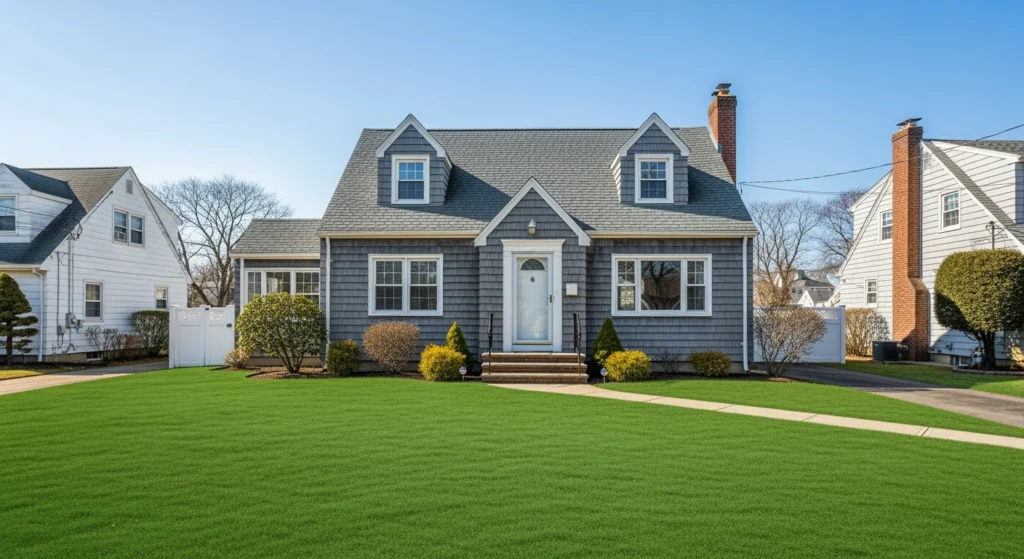
Drive through the older neighborhoods of Long Island — Levittown, Hicksville, Massapequa, Farmingdale, Lindenhurst, Babylon, Freeport — and you will see thousands of homes clad in asbestos cement siding. Manufactured from the 1920s through the 1970s under brands like Johns-Manville, Eternit, GAF, and Certain-Teed, these dense, rigid shingles were prized for their fireproofing and durability. Decades later, they remain on homes across Nassau and Suffolk Counties, and homeowners face practical questions about safety, maintenance, and what to do when it is time for new siding.
Is Your Siding Asbestos? How to Tell
Asbestos cement siding has distinctive characteristics that help distinguish it from later non-asbestos alternatives. The shingles are rigid and heavy — noticeably denser than vinyl, aluminum, or modern fiber cement. They do not flex when pushed; they crack or break. The surface is often stamped with a wood-grain pattern, though smooth-faced versions also exist. Color is typically gray, white, or occasionally light tan or green. Shingle dimensions vary but most are roughly 12 inches tall by 24 inches wide, with straight or scalloped bottom edges.
The age test: If your Long Island home was built or re-sided before 1980, and the siding material is rigid, cementitious (not metal or plastic), and breaks rather than bends, it should be assumed to contain asbestos until tested. Modern fiber cement siding (like James Hardie, introduced in the 1980s) looks similar but post-dates asbestos use.
Confirm with testing: The only definitive way to confirm asbestos content is laboratory analysis. A NYS DOH-certified inspector can collect a small chip sample and submit it for PLM analysis. Cost: $200-$400 for a siding-specific inspection on Long Island.
Living with Asbestos Siding: When It Is Safe
The key fact about asbestos cement siding is that it is non-friable when intact. Unlike pipe insulation or popcorn ceilings, siding does not crumble, flake, or release fibers under normal weathering conditions. The asbestos fibers are locked in a cement matrix and are not released unless the material is physically damaged.
Safe activities: Painting asbestos siding, washing it gently by hand or with a low-pressure hose, and making minor repairs with compatible caulk or patching compounds are all safe when done without cutting, drilling, or breaking the material.
Activities that create risk: Cutting asbestos siding with a power saw, drilling through it for mounting hardware, breaking shingles during removal, and pressure washing at high PSI all release asbestos fibers and require proper precautions or professional handling.
Your Options When It Is Time for New Siding
Option 1: Install new siding over the existing asbestos siding. This is the most common approach on Long Island and typically the most cost-effective. Vinyl, fiber cement, or engineered wood siding can be installed directly over intact asbestos shingles, which serve as a substrate. The asbestos remains safely encapsulated and undisturbed. Standard siding installation pricing applies — no abatement costs. Many Long Island contractors routinely perform this work.
Option 2: Remove the asbestos siding professionally. When the existing siding is too deteriorated to serve as a substrate, or when the homeowner wants to eliminate the material entirely, a NYS DOL-licensed abatement contractor removes the shingles using wet methods and proper waste handling. Cost: $5 to $15 per square foot of siding removed, plus new siding installation costs. A typical 1,500-square-foot Long Island home exterior runs $7,500 to $22,500 for removal alone.
Option 3: Targeted repair and maintenance. Individual damaged or broken shingles can be carefully removed and replaced (by a licensed handler if the material is confirmed asbestos) or patched. This approach extends the life of existing siding without the cost of full removal or re-siding.
Repair and Maintenance Tips for Long Island Homeowners
Painting: Asbestos cement siding holds paint well. Use a high-quality exterior latex primer formulated for masonry surfaces, followed by acrylic latex topcoat. Do NOT sand or scrape the siding before painting — simply clean the surface with a garden hose and allow it to dry. Repainting every 10-15 years maintains appearance and adds a protective layer.
Cleaning: Hand washing with a brush and garden hose is safe. Low-pressure rinsing is acceptable. Do NOT use a high-pressure power washer — pressures above 1,500 PSI can damage the surface and release fibers.
Replacing broken shingles: Individual broken shingles should be handled carefully. Wet the broken pieces, collect them in a plastic bag, and dispose of them properly. Replacement with a matching non-asbestos fiber cement shingle is straightforward for an experienced siding contractor. If multiple shingles need replacement, consulting a licensed asbestos handler is prudent.
Real Estate Implications on Long Island
Asbestos siding is common enough on Long Island that it rarely surprises experienced home inspectors or real estate agents. However, disclosure is important. New York’s Property Condition Disclosure Act encourages sellers to disclose known material conditions, and many home inspectors routinely flag siding that appears to be asbestos cement. The presence of asbestos siding typically does not prevent a sale but may affect negotiations. Some buyers request a credit for future re-siding; others accept the material as-is, understanding that intact asbestos siding is not a health hazard.
Upper Restoration’s Siding Abatement Services
When Long Island homeowners need professional asbestos siding removal, Upper Restoration provides licensed abatement services across Nassau and Suffolk Counties. Our crews remove asbestos shingles using wet methods, package waste to regulatory standards, and coordinate disposal through registered transporters. We also work with general contractors to coordinate removal timing with new siding installation, minimizing the window when your home is without exterior cladding.