Why Asbestos Insulation Is the Highest-Risk Category in Pre-1980 Buildings
Of all asbestos-containing materials found in New York’s older building stock, insulation carries the highest risk profile. The reason is friability. Floor tiles and ceiling tiles bind asbestos fibers within a solid matrix — they’re relatively stable when intact. Insulation materials are different: pipe lagging, boiler wrap, and many forms of spray-applied insulation crumble under light pressure, releasing respirable chrysotile and amosite fibers into the air.
The Occupational Safety and Health Administration (OSHA) identifies thermal system insulation (TSI) — pipe insulation, boiler insulation, and duct insulation — as among the highest-priority asbestos materials for exposure control. In the dense pre-war and post-war building stock of NYC and Long Island, this material is present in virtually every building constructed before 1975.
Types of Asbestos Insulation Found in NYC and Long Island Buildings
1. Pipe Insulation and Lagging
The most common asbestos insulation type in NYC and Long Island. Steam pipes, hot water pipes, and heating distribution pipes in pre-1975 buildings were almost universally wrapped with asbestos-containing insulation — typically a corrugated or molded pipe covering, sometimes wrapped in cloth tape called lagging cloth. This material is routinely friable, particularly in older buildings where it has been disturbed by maintenance work over decades.
Visual identification: chalky white or grey pipe covering, often crumbling at joints and elbows, sometimes with cloth wrap partially detached. Any pipe insulation in a pre-1975 NYC or Long Island building should be treated as asbestos-containing until tested.
2. Boiler and Furnace Insulation
Pre-1980 boilers, furnaces, and their associated fittings were heavily insulated with asbestos-containing materials — both the boiler jacket itself and the cement used to seal joints and connections. In Long Island homes with original oil-fired furnaces or steam boilers, asbestos insulation on the unit and the distribution pipes is extremely common.
This is also the category where homeowners are most often unknowingly exposed: a plumber or HVAC technician who breaks open deteriorated boiler insulation during a service call can release significant fiber concentrations in an enclosed basement space.
3. Vermiculite Attic Insulation
Vermiculite attic insulation — sold under the brand name Zonolite — was widely installed in American homes from the 1940s through the 1990s. The EPA has determined that the vast majority of U.S. vermiculite came from a mine in Libby, Montana that was contaminated with tremolite asbestos. The EPA recommends treating all vermiculite insulation as potentially asbestos-containing.
Visual identification: lightweight, pebble-like granules, typically grey-silver or gold in color, poured loose between attic joists. Commonly found in Long Island colonial and ranch attics built from the 1950s through the 1970s.
4. Spray-Applied Insulation and Fireproofing
Spray-applied asbestos was used extensively in commercial and multi-family buildings — applied to steel beams, concrete decks, and mechanical room ceilings as fireproofing and thermal insulation. In NYC’s older office buildings, apartment buildings, and schools, spray-applied asbestos fireproofing on structural steel is a major remediation category. Under AHERA, all K-12 schools must inspect for and manage this material.
5. Insulation Board (AIB)
Asbestos insulation board was used as backing material, partition panels, and fire barriers in both residential and commercial construction. Common in pre-1980 boiler room walls, electrical panel surrounds, and partition walls in industrial buildings. AIB is semi-friable — harder than pipe insulation but still capable of releasing fibers when cut or broken.
6. Duct Insulation and Duct Tape
HVAC ductwork in pre-1980 buildings was often wrapped with asbestos-containing insulation, and the grey cloth tape used to seal duct joints frequently contained asbestos. When HVAC systems are serviced or replaced in older NYC and Long Island buildings, this material is routinely disturbed. Gray cloth HVAC tape from the pre-1980 era should always be tested before being cut or removed.
Visual Identification Guide: What to Look For
| Material | Appearance | Common Location | Risk Level |
|---|---|---|---|
| Pipe lagging / wrap | White/grey corrugated wrap, cloth tape, crumbling at joints | Basement pipes, boiler rooms | High (friable) |
| Boiler insulation | White cement-like coating, patchy deterioration | Basement boilers | High (friable) |
| Vermiculite | Pebble-like silver/gold granules, loose fill | Attic between joists | High (disturbed easily) |
| Spray fireproofing | Fluffy or textured grey/white coating on steel | Commercial ceilings, beams | Very high (friable) |
| Insulation board (AIB) | Flat grey board, rigid panels | Boiler room walls, electrical | Medium (semi-friable) |
| Duct tape / wrap | Grey cloth tape on ductwork | HVAC systems | Medium-high when cut |
New York State Requirements for Asbestos Insulation
Thermal system insulation (TSI) — the regulatory category covering most pipe and boiler insulation — is subject to the strictest requirements under NYS Industrial Code Rule 56:
- Any disturbance of TSI must be performed by a licensed asbestos contractor
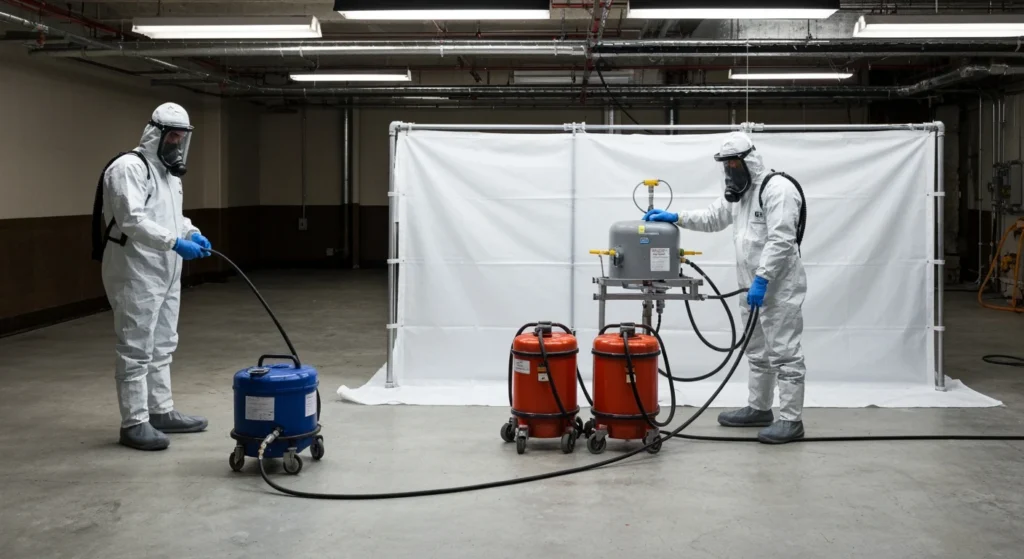
- Full containment with negative air pressure is required for friable TSI removal
- Air monitoring by a licensed industrial hygienist is mandatory throughout the project
- NYS DOL notification is required at least 10 business days before work above threshold quantities
- Post-abatement clearance air testing is required before the space can be reoccupied
In NYC, Local Law 76 requires an asbestos investigation before any renovation touching building systems in pre-1987 buildings — meaning even a routine boiler replacement triggers testing requirements if the building predates 1987 and asbestos pipe insulation is present.
What to Do If You Suspect Asbestos Insulation
- Do not disturb it. Leave the material alone. Do not break, cut, remove, or attempt to sample it yourself. Even walking through an area with deteriorated pipe insulation can re-suspend settled fibers.
- Have it tested. Contact a licensed NYS asbestos inspector for professional sampling. Testing costs $300–$700 for most residential scopes.
- Assess the condition. Intact, well-bonded insulation in good condition may not require immediate removal — encapsulation or management-in-place may be appropriate. Deteriorated or friable material typically requires abatement before any work in the area proceeds.
- Get a written remediation plan. Any abatement project requires a written scope of work from a licensed contractor before signing anything.
Upper Restoration’s licensed asbestos inspectors assess pipe insulation, boiler insulation, vermiculite, and other insulation materials across NYC and Long Island. We provide written inspection reports, sampling results from NVLAP-accredited laboratories, and remediation recommendations — with no obligation to use our abatement services.
Frequently Asked Questions About Asbestos Insulation
What does asbestos pipe insulation look like?
Asbestos pipe insulation typically appears as a white or grey corrugated wrap around pipes, sometimes covered in a grey or tan cloth tape called lagging cloth. It often shows crumbling or chalky deterioration at pipe joints, elbows, and valves. In advanced deterioration, you may see loose fibrous material around fittings or on surfaces below the pipe. Any pipe insulation in a pre-1975 NYC or Long Island building should be treated as potentially asbestos-containing until tested.
Is vermiculite insulation in my attic dangerous?
The EPA recommends treating all vermiculite attic insulation as potentially asbestos-containing because the vast majority of U.S. vermiculite came from a mine in Libby, Montana that was contaminated with tremolite asbestos. Intact, undisturbed vermiculite in an attic that is not regularly accessed poses relatively low risk. The danger rises sharply during renovation work, HVAC service, or any activity that disturbs the material. Professional testing and, where contamination is confirmed, licensed abatement is recommended before any attic work.
Can a plumber or HVAC technician work around asbestos pipe insulation?
No — not legally in New York. If a plumber or HVAC technician needs to disturb, cut through, or remove asbestos pipe insulation to access the pipe or system, that work must be preceded by licensed asbestos abatement. A plumber who tears through deteriorated pipe insulation without testing or containment is creating an exposure event and a regulatory violation. The correct sequence is: test the insulation, abate if confirmed asbestos, then proceed with the plumbing or HVAC work.
How much does asbestos pipe insulation removal cost?
Asbestos pipe insulation removal in NYC and Long Island runs $25–$75 per linear foot depending on pipe diameter, accessibility, and material condition. A typical Long Island basement with 20–40 linear feet of pipe insulation costs $1,500–$4,000. Full boiler room abatement including the boiler jacket, associated piping, and fittings typically runs $5,000–$15,000.
What is the most dangerous type of asbestos insulation?
Spray-applied asbestos fireproofing — used extensively on structural steel in commercial and multi-family buildings — is the highest-risk category due to extreme friability. Among residential materials, deteriorated pipe insulation and boiler insulation rank highest. Vermiculite is hazardous primarily when disturbed. Asbestos insulation board (AIB) is semi-friable and requires professional handling but is less immediately dangerous than spray fireproofing or deteriorated pipe lagging.
Does asbestos insulation need to be removed or can it be left alone?
The EPA and NYS guidance supports management-in-place for intact, non-deteriorated asbestos insulation that will not be disturbed. If pipe insulation is in good condition, firmly bonded, and not subject to renovation activity, leaving it alone with regular monitoring is often the recommended approach. Removal is required when material is deteriorating, when it will be disturbed by renovation or repair work, or when the building will undergo demolition. A licensed asbestos inspector can assess condition and provide written recommendations.