If your Long Island home was built before 1980 and you’re planning any renovation—new floors, a kitchen gut, removing old tile—there’s a good chance you need to know whether those floor tiles contain asbestos. This guide helps you understand what to look for, what the 9×9 rule means, and what to do if testing confirms the worst.
What Years Were Asbestos Floor Tiles Used in Homes?
Asbestos was added to vinyl floor tiles primarily between the 1920s and the mid-1980s, with peak use from the 1950s through the 1970s. The EPA began restricting asbestos use in 1973, and most manufacturers phased it out by 1986. However, existing inventory of asbestos-containing tiles was sold through the late 1980s.
If your Long Island home was built between 1950 and 1986, and the original floor is still in place (or covered under newer flooring), asbestos tile is a serious possibility. Nassau and Suffolk County have a large stock of mid-century homes—colonials, capes, ranch homes, and split-levels—built during exactly this window.
Visual Signs Your Floor Tiles May Contain Asbestos
You cannot confirm asbestos by looking at tiles—only lab testing can do that. But visual cues help identify which tiles are worth testing:
Size
The strongest visual indicator is size. 9×9 inch tiles are the most common asbestos-containing floor tile format used in residential construction. 12×12 tiles were also used with asbestos, but less commonly. If you have 9×9 tiles in your basement, kitchen, or bathroom, treat them as suspect until tested.
Color and Pattern
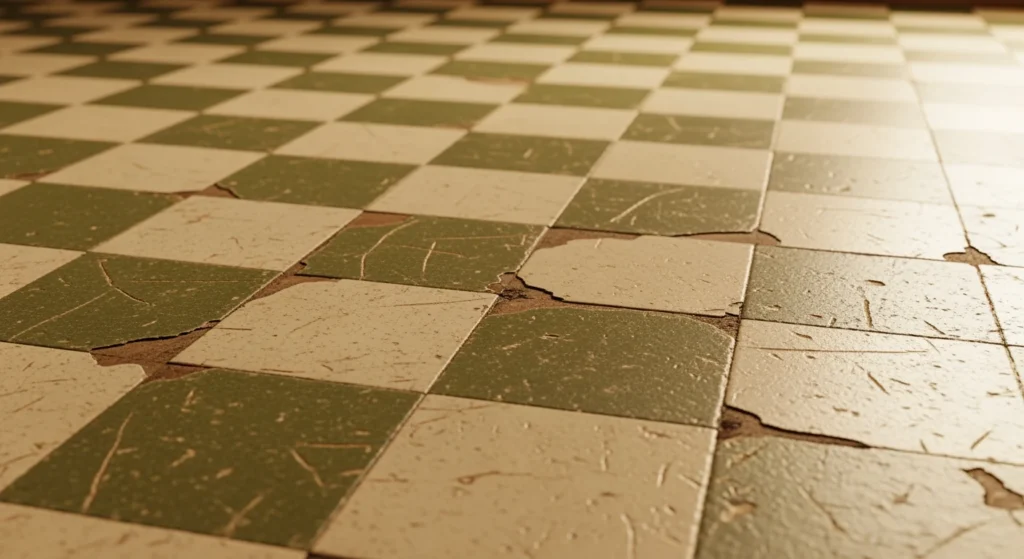
Asbestos vinyl tiles tend to have a marbled or speckled appearance—browns, tans, greens, grays, and brick reds were common mid-century colors. Solid colors are less typical but not impossible. The distinctive marbled pattern of “VAT” (vinyl asbestos tile) is recognizable once you know what to look for.
Age of the Home
Any resilient tile in a Long Island home built before 1980 should be presumed to contain asbestos unless tested. This is the standard professional approach: assume ACM, test before disturbing.
Condition
Tiles that are cracking, crumbling, lifting, or showing the adhesive layer underneath are considered “friable”—more likely to release fibers when disturbed. Intact, well-adhered tiles in good condition present less risk but still require testing before any renovation work.
The 9×9 Rule: Why That Tile Size Is a Red Flag
The 9×9 inch dimension became a shorthand warning sign in the renovation industry for a simple reason: nearly all 9×9 vinyl tiles manufactured before the late 1970s contained asbestos. Armstrong, Kentile, Azrock, and Congoleum—the major flooring manufacturers of that era—used chrysotile asbestos as a binding and strengthening agent in their 9×9 product lines.
The fibers made the tiles more durable, resistant to compression, and stable across temperature changes—exactly the properties needed for basement and kitchen floors. The downside wasn’t understood until decades later.
If you see 9×9 tiles in a pre-1980 Long Island home, this is the professional standard: do not cut, drill, sand, scrape, or break them until they have been tested.
What About the Black Adhesive Under the Tiles?
This is a detail that catches many homeowners and contractors off guard: the black mastic adhesive used to install asbestos floor tiles often contains asbestos itself. Even if the tiles are removed intact, the adhesive layer left behind may be an independent source of ACM.
Black cutback adhesive, widely used for tile installation from the 1950s through the early 1980s, frequently contained asbestos. When this adhesive is scraped, ground down, or disturbed by floor preparation tools, it can release fibers.
This means asbestos floor tile remediation is a two-step concern: the tiles themselves, and the adhesive underneath. A certified abatement contractor addresses both. Upper restoration’s process covers tile removal and mastic treatment—either removal or encapsulation depending on the substrate and the renovation plans.
How to Confirm: Asbestos Testing for Floor Tiles
Visual inspection is not enough. The only way to confirm asbestos in floor tiles is polarized light microscopy (PLM) analysis of a physical sample. Here’s what that process looks like:
- A certified inspector collects a small sample of the tile (and if accessible, a sample of the adhesive) using wet methods to minimize fiber release.
- Samples are sent to an accredited laboratory.
- Results are returned within 24–72 hours, showing whether asbestos is present and at what percentage.
- Materials with more than 1% asbestos are regulated as asbestos-containing material (ACM) under EPA NESHAP.
Testing one tile from each distinct tile type in the home is standard. If you have the same 9×9 brown tile throughout the basement and kitchen, one sample from each room is typical.
What to Do If Your Tiles Test Positive
A positive result doesn’t mean immediate crisis. Your options depend on the condition of the tiles and your renovation plans:
- Leave in place and cover: If tiles are in good condition and the renovation allows for new flooring over the top (without adhesives or leveling compounds that require grinding), encapsulation by covering is often the safest and least expensive option.
- Encapsulate: Apply an approved sealant to the tiles and adhesive to prevent fiber release. Works for tiles that will be left in place but in an area that will be used.
- Licensed abatement: Required when tiles are damaged, friable, or when the renovation requires removal. Under New York law, asbestos floor tile removal must be performed by a NYS-licensed, NYC DEP-certified abatement contractor.
New York Regulations for Asbestos Floor Tile Removal
New York has specific regulatory requirements for asbestos floor tile removal that go beyond federal EPA standards. In New York City, any asbestos abatement project requires notification to the NYC DEP before work begins. On Long Island, projects follow NYS DOL asbestos regulations and EPA NESHAP requirements.
The key rule: only a licensed contractor may perform asbestos floor tile removal in New York. Homeowners attempting DIY removal face potential fines, liability, and health risk. The cost difference between licensed removal and DIY is far smaller than the cost of remediation if improperly disturbed asbestos contaminates a living space.
Upper Restoration is NYS-licensed and NYC DEP-certified for asbestos abatement. We serve Nassau County, Suffolk County, and all five boroughs. We’ll connect you with a certified inspector and provide a free abatement consultation.
Call: | Free Consultation
Frequently Asked Questions
Are all 9×9 floor tiles asbestos?
Not all 9×9 tiles contain asbestos, but the vast majority of 9×9 vinyl tiles manufactured before the late 1970s do. Only lab testing can confirm. If your home was built before 1980 and has 9×9 resilient tiles, treat them as suspect until a certified lab analysis proves otherwise.
Can I install new flooring over asbestos tiles?
Yes, if the tiles are intact and in good condition. Installing new flooring directly over undisturbed asbestos tiles is a common and accepted encapsulation method. The tiles must not be cut, sanded, or drilled during the installation. A licensed contractor should assess the specific situation before work begins.
Is the black adhesive under old floor tiles also asbestos?
Frequently, yes. Black cutback adhesive used from the 1950s through the early 1980s often contained asbestos. It must be sampled and tested separately from the tiles themselves. Do not grind, scrape, or sand black mastic without testing first.
Need professional asbestos abatement on Long Island? Upper Restoration provides licensed asbestos abatement and removal services across NYC and Long Island. Contact us for a free assessment.