Why Older Homes in the Tri-State Area Are at Risk
Homes built or renovated between the 1920s and the late 1980s across the five boroughs, Long Island, New Jersey, Pennsylvania, and Connecticut have a meaningfully higher chance of containing asbestos flooring than homes built after 1990. Asbestos-containing tiles and adhesives were phased out gradually, not banned outright, so the risk window stretches across six decades of housing stock.
Asbestos flooring hit the market as early as the 1920s and stayed common in American homes through the 1970s, according to industry documentation from AirPF.1 Construction and renovation activity between 1950 and the 1980s carries a particularly high probability of asbestos-containing tile or adhesive, per Asbestos123.2 Cove Flooring & Design notes that asbestos-containing building materials remained in widespread use until the late 1980s, well past the point most homeowners assume the risk ended.3
If you own a pre-1980s brownstone in Brooklyn, a Cape Cod on Long Island, a rowhouse in Philadelphia, or a mid-century colonial in Fairfield County, the flooring under your carpet, laminate, or self-adhesive vinyl might be original. That’s not a reason to panic. It’s a reason to look closely before you start swinging a hammer at it.
The “9×9 Rule”: Tile Size as the First Clue
Tile size is the single fastest visual screening tool. Nine-inch-by-nine-inch tiles manufactured before 1980 carry a very high probability, sometimes cited above 90%, of containing asbestos. Twelve-inch and eighteen-inch tiles from the same era are also frequent carriers, though size alone never confirms or rules out asbestos.
Environmental firms refer to this shortcut as the “9-inch rule.” Banner Environmental Services explains that 9″×9″ tiles, especially those installed before 1980, show an extremely high likelihood of asbestos content.4 Upper Restoration’s own field guidance confirms that tiles manufactured from the 1950s through the early 1970s at 9″×9″ carry an “extremely high” probability, and that 12″×12″ tiles from the same era are also frequent carriers.5 Twelve-by-twelve tiles became the dominant size industry-wide starting in the mid-1970s as manufacturers shifted formulations, so a 12″ tile doesn’t clear your floor, it just shifts the odds slightly.
Thickness matters too. Asbestos tiles are often thin and rigid, typically 1/16″, 3/32″, or 1/8″, and feel noticeably stiffer underfoot than the flexible vinyl composition tiles sold today.4 Modern luxury vinyl tile flexes; a lot of older asbestos vinyl tile does not.
Here’s the caveat worth remembering before you get too confident in a tape measure: some non-asbestos tiles were manufactured in 9″×9″ formats, and asbestos-containing tiles continued to be produced in 12″×12″ sizes well into the 1980s.4 Size is a screening clue, not a verdict.
| Tile Size | Common Era | Asbestos Probability |
|---|---|---|
| 9″ × 9″ | 1950s, early 1970s | Extremely high, especially pre-1980 |
| 12″ × 12″ | 1950s, 1980s | Moderate to high |
| 18″ × 18″ | 1960s, 1970s | Occasional, lower frequency |
Color and Pattern Clues to Watch For
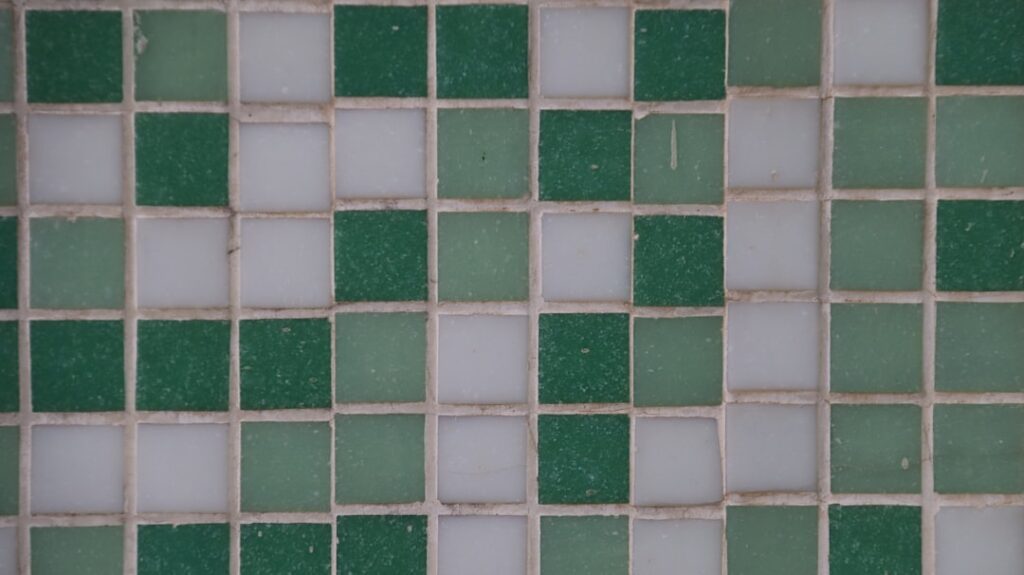
Speckled or marbled tiles in cream, beige, light blue, pink, green, maroon, or black are strongly associated with older vinyl asbestos tile lines. A grimy or oily surface discoloration is another common visual signature on asphalt-based asbestos tiles, distinct from ordinary dirt buildup.
AirPF documents light blue, cream, pink, and green as recurring colors in vinyl asbestos tile catalogs from this period.1 Upper Restoration’s visual identification guide adds that speckled or marbled patterns in cream, beige, black, green, and maroon tones show up repeatedly across vinyl asbestos tile product lines from the 1950s through the 1970s.5 One detail worth training your eye on: green flecks embedded in the tile surface, particularly in flooring installed between the 1950s and 1970s, are frequently chrysotile asbestos fibers that manufacturers used as a decorative filler.5 If you see tiny green flecks scattered through an otherwise plain cream or beige tile, treat that as a strong visual flag, not decoration.
Asphalt-based asbestos tiles also tend to develop an oily discoloration or dark staining over decades, as petroleum-based binders slowly migrate to the surface.2,1 That grimy sheen that won’t scrub off with regular floor cleaner is worth photographing, not scraping at.
Quick visual scan: Speckled cream, beige, or black patterns; green flecks; oily or grimy discoloration; tiles that feel rigid rather than flexible. None of these confirm asbestos on their own, but two or more together are worth a professional look.
Black Mastic Adhesive: A Second Red Flag
Thick, black, tar-like adhesive found under old tiles, often called “black mastic” or cutback adhesive, is a strong independent indicator of asbestos, separate from whatever the tile itself is made of. Even if the tile tests clean, the mastic underneath frequently does not.
Asbestos123 and AirPF both flag black mastic as one of the most reliable visual cues homeowners can spot, precisely because it was formulated with asbestos fibers for durability and fire resistance independent of tile composition.2,1 Upper Restoration’s guidance reinforces that tile and mastic are chemically distinct materials and need to be evaluated as two separate risks.5 A homeowner discussion thread on r/DIY echoes the same field experience: black adhesive under tile, being asphalt-based, is commonly asbestos-containing whether or not the tile above it is.6 That’s anecdotal, not a lab standard, but it lines up with what environmental contractors see on job sites constantly.
This is why pulling up “just one tile” to check is a trap. Lifting a tile exposes the mastic layer underneath, and that layer is often the more friable, more easily disturbed material of the two. Upper Restoration recommends testing tile and mastic as separate samples, and if either comes back positive, abatement planning should account for both.5
Does the Age of Your Home or Renovation Matter?
Yes. The construction or last major renovation date of your home is one of the most reliable risk indicators available, more reliable than color or pattern alone. Homes built or renovated between 1950 and the 1980s carry meaningfully elevated risk, and checking permit history or manufacturer stamps can sharpen that estimate further.
Asbestos123 places the highest-risk renovation window between 1950 and the 1980s.2 If your kitchen was last redone in 1968 and nobody has touched the subfloor since, that’s a different risk profile than a kitchen gutted in 2015. Cove Flooring & Design notes that checking building records or past renovation permits can add useful context, though records are frequently incomplete or simply unavailable for older residential properties.3
One underused trick: if a tile is already loose or missing along an edge, wiping away the old adhesive from its backing can sometimes reveal a manufacturer name or product code, which can be cross-referenced against known asbestos-containing product lists.1 This only applies to tiles that are already loose or detached, not tiles you pry up yourself. If nothing is loose, don’t create a loose edge to go looking.
Warning Signs That Mean Stop Immediately
Cracking, peeling, powdering, or chalky tile surfaces mean the material may already be friable, meaning fibers can release into the air with minimal disturbance. Any plan to sand, scrape, drill, or forcibly remove suspect tile should stop the moment you notice these signs, and the room should be treated as off-limits for renovation work until it’s assessed.
Banner Environmental Services identifies cracking, peeling, and powdery deterioration as the specific conditions that raise friability risk, because intact asbestos tile in good condition is generally low-risk when left undisturbed.4 That’s an important distinction: the danger isn’t the tile sitting quietly under your feet, it’s disturbing it. Cove Flooring & Design and Upper Restoration both note that intact, undisturbed asbestos flooring is often safer left in place, or covered with new flooring on top, than removed through amateur demolition.3,5
Do not sand, scrape, drill, or aggressively pry up tiles you suspect contain asbestos.5 If you’ve already got a hammer drill out for a basement renovation and you’re staring at cracked 9″×9″ tile with black mastic showing through, put the tool down. If contact with suspect material is genuinely unavoidable in the short term, basic PPE, an N95 or better respirator mask, gloves, and goggles, reduces exposure while you arrange proper testing.3 A Facebook homeowner community thread reinforces the same practical takeaway from real renovation projects: 9″×9″ tile in pre-1980 homes gets treated as likely asbestos by default, with testing and careful handling recommended before any further work.7
If you’ve already disturbed suspect tile: Stop work immediately, leave the area, ventilate if possible without spreading dust further, and avoid sweeping or vacuuming debris with a standard vacuum, which can aerosolize fibers. Contact a licensed environmental testing or abatement professional before resuming any work in that space.
What Visual Clues Can’t Tell You (Why Lab Testing Is Required)
Visual identification, tile size, color, pattern, adhesive type, and building age, can only flag flooring as “suspect.” No amount of expert eyeballing confirms asbestos content. Only laboratory analysis of a physical sample, collected by a licensed professional, provides a legally and scientifically reliable answer.
Every source behind this identification checklist agrees on this point without exception. Tile size and pattern raise or lower probability; they don’t produce certainty. Non-asbestos tiles were manufactured in classic 9″×9″ dimensions, and asbestos-containing tiles were produced in 12″×12″ formats well past the point most people assume the risk ended.4 Two identical-looking cream speckled tiles from the same era, in the same style, can have different compositions depending on the manufacturer, the plant, and the specific product run.
This is the core reason a visual checklist exists as a triage tool, not a diagnostic one. It tells you when to stop and call someone, not whether you’re actually looking at asbestos. Treating a “probably fine” visual read as a green light to start demolition is the single most common mistake DIY renovators make with older flooring.
What To Do Next: Testing, Covering, or Calling a Licensed Contractor
Once you’ve flagged suspect flooring, you have three realistic paths: leave it undisturbed and cover it with new flooring on top, arrange for a licensed professional to collect and lab-test a sample, or bring in a licensed abatement contractor if testing confirms asbestos and removal is necessary. Which path makes sense depends on your renovation plans and the tile’s condition.
If the tile is intact, flat, and you’re not planning to disturb the subfloor, covering it with new flooring is frequently the lower-risk, lower-cost option, since intact asbestos material poses minimal risk when left alone.3,5 If your renovation plan requires removing the existing floor, or the tile shows cracking, powdering, or lifting, testing comes first, full stop. Licensed environmental professionals collect samples according to established protocols and send them to accredited labs, which is the only method that produces a defensible result for both safety and future disclosure purposes.
If results come back positive, abatement needs to be handled by a licensed contractor following jurisdiction-specific regulations, not a weekend DIY project with a shop vac and good intentions. Licensing requirements and permitted procedures vary by state and municipality across the tri-state footprint, which is exactly the kind of detail worth confirming with a professional before work begins rather than after.
Spotted suspect tile during a renovation project? Upper Restoration serves homeowners across NYC, Long Island, NJ, PA, and CT with licensed testing and abatement support.
Frequently Asked Questions
What size floor tiles are most likely to contain asbestos?
Nine-inch-by-nine-inch tiles installed before 1980 carry the highest probability of asbestos content, sometimes cited above 90% in older housing stock. Twelve-inch and eighteen-inch tiles from the 1950s through the 1980s also frequently contain asbestos. Tile size is a screening indicator, not confirmation, since asbestos-free tiles were also produced in these dimensions.
What color are asbestos floor tiles usually?
Common colors include cream, beige, light blue, pink, green, maroon, and black, often in speckled or marbled patterns. Green flecks embedded in the tile surface, particularly in flooring from the 1950s through 1970s, are frequently chrysotile asbestos fibers used as a decorative filler. Color and pattern support a visual assessment but cannot confirm asbestos content without lab testing.
Is the black sticky adhesive under my tiles asbestos?
Thick black adhesive, often called black mastic or cutback adhesive, is commonly asbestos-containing, independent of whether the tile above it contains asbestos. This adhesive was widely used in construction through the 1970s and 1980s for its durability and fire resistance. Both tile and adhesive should be tested separately by a licensed professional to confirm content.
Is it safe to pull up one tile myself to check for asbestos?
No. Lifting or disturbing suspect tile can release fibers into the air, and it also exposes the adhesive layer underneath, which is frequently more friable than the tile itself. Intact, undisturbed asbestos flooring generally poses low risk. The safer approach is visual inspection only, followed by professional sample collection if the flooring appears suspect.
Does my home’s age or renovation history matter for asbestos risk?
Yes. Homes built or renovated between 1950 and the 1980s carry meaningfully higher risk of asbestos-containing flooring and adhesive than homes built after 1990. Checking permit records or renovation history can add context, though records are often incomplete for older residential properties. Building age is one of the more reliable risk indicators available before lab testing.
What should I do if I already disturbed suspect asbestos tile?
Stop work immediately and leave the area. Avoid sweeping or vacuuming debris with a standard household vacuum, which can aerosolize fibers into the air. Ventilate the space if possible without spreading dust further, and contact a licensed environmental testing or abatement professional before resuming any renovation work in that room.
Can visual inspection alone confirm asbestos in floor tiles?
No. Visual traits like tile size, color, pattern, and adhesive type can flag flooring as suspect, but only laboratory analysis of a physical sample, collected by a licensed professional, can confirm asbestos content. Identical-looking tiles from the same era can have different compositions depending on manufacturer and production run, making visual identification a screening step rather than a diagnosis.
Sources
- AirPF, “Asbestos Floor Tiles: What Does Asbestos in Flooring Look Like?” airpf.com
- Asbestos123, “How to Recognize Asbestos Floor Tiles” asbestos123.com
- Cove Flooring & Design, “How to Tell If Tile Is Asbestos” coveflooringdesign.com
- Banner Environmental Services, “What Does Asbestos Tile Look Like: 9-Inch Rule” bannerenvironmental.com
- Upper Restoration, “What Do Asbestos Floor Tiles Look Like? A Visual Identification Guide” upperrestoration.com
- r/DIY community discussion, “Help identifying if old tile contains asbestos” reddit.com
- Facebook homeowner community discussion (regional renovation group) facebook.com
This content is for general informational purposes only and is not legal, medical, or insurance advice. Remediation scope, timelines, and costs vary by site conditions. Contact Upper Restoration for a professional assessment. Licensing and certifications apply per jurisdiction.