Why Ceiling Tiles Were Made With Asbestos
From the 1940s through the late 1970s, asbestos was added to ceiling tiles because it solved multiple engineering problems simultaneously. It provided fire resistance, sound dampening, thermal insulation, and structural rigidity — all in a lightweight tile that could be mass-produced cheaply. Manufacturers including Armstrong, National Gypsum, and Celotex produced millions of asbestos-containing ceiling tiles installed in schools, offices, hospitals, and homes across the country.
The U.S. Environmental Protection Agency did not begin restricting asbestos use in building materials until the late 1970s, and many products remained in use through the early 1980s. If your building was constructed or renovated before 1986, there is a meaningful probability that ceiling tiles — particularly acoustic drop ceiling tiles — contain asbestos.
How to Identify Asbestos Ceiling Tiles: Six Visual Indicators
Visual identification of asbestos ceiling tiles is not definitive — laboratory testing is the only way to confirm asbestos content. However, these six characteristics indicate high probability and should trigger professional testing before any disturbance:
1. Age: Installed Before 1980
Any ceiling tile installed before 1980 should be treated as potentially asbestos-containing until tested. This applies to original installations and any renovation work completed during that period. Building permits and contractor records from the era often document materials used.
2. Size: 9×9 Inch or 12×12 Inch Tiles
The most commonly asbestos-containing ceiling tiles were manufactured in 9×9 inch and 12×12 inch squares. This size was standard for acoustic ceiling tiles produced from the 1950s through the 1970s. Modern replacement tiles are typically 24×24 or 24×48 inches. If your drop ceiling has smaller square tiles, this is a significant indicator.
3. Texture: Fibrous or Dimpled Surface
Asbestos-containing acoustic ceiling tiles frequently have a distinctive fibrous or pitted texture — small holes or a rough surface designed to absorb sound. This texture resulted partly from the asbestos fiber matrix within the tile. Smooth or painted-over tiles are harder to assess visually and require testing regardless.
4. Discoloration and Staining Patterns
Older asbestos ceiling tiles often show yellowing, brown water stains, or uneven discoloration that has developed over decades. While staining alone does not confirm asbestos, it indicates age. It also indicates potential disturbance from water damage — a situation that elevates risk if fibers have been loosened.
5. Grid System and Installation Method
Suspended ceiling grid systems with lightweight drop-in tiles were heavily associated with asbestos-containing products. If the tile simply rests in a metal grid rather than being glued or nailed directly to a structure, and the building predates 1980, the combination strongly suggests testing is warranted.
6. Manufacturer Markings
Some asbestos-containing ceiling tiles have manufacturer stamps or lot numbers on the back face. Brands including Armstrong Excelon, National Gypsum, Celotex, and Johns Manville produced confirmed asbestos-containing ceiling products. If you can safely view the back of a tile without disturbing it, manufacturer information can help guide testing priorities.
Asbestos Ceiling Tiles vs. Non-Asbestos Ceiling Tiles
| Characteristic | Likely Asbestos-Containing | Likely Asbestos-Free |
|---|---|---|
| Installation date | Pre-1980 | Post-1986 |
| Tile size | 9×9 or 12×12 inches | 24×24 or 24×48 inches |
| Surface texture | Fibrous, pitted, dimpled | Smooth, uniform |
| Color | Yellowed, stained, aged | Bright white, consistent |
| Grid type | Older suspended grid | Modern T-bar grid |
| Confirmation method | Laboratory PLM analysis only | Laboratory PLM analysis only |
The Only Way to Confirm Asbestos: Laboratory Testing
Visual assessment creates suspicion. Laboratory testing creates facts. The standard method for confirming asbestos in building materials is Polarized Light Microscopy (PLM) analysis, performed by an NVLAP-accredited laboratory on a bulk sample of the material.
In New York State, asbestos sampling in buildings must be performed by a licensed asbestos inspector. Under New York State Department of Health regulations (10 NYCRR Part 73), any person collecting asbestos samples for analysis in a commercial or public building must hold a valid NYS Asbestos Inspector certificate. Homeowners may sample their own residence, but professional sampling is strongly recommended to avoid contaminating the sample or disturbing fibers during collection.
Upper Restoration’s licensed asbestos inspectors collect samples under proper containment protocols and submit them to accredited labs with typical results returned in 24–72 hours.
Are Intact Asbestos Ceiling Tiles Dangerous?
The EPA’s guidance on asbestos in the home distinguishes between friable and non-friable asbestos. Intact, undisturbed asbestos ceiling tiles in good condition are classified as non-friable — meaning fibers are bound within the tile matrix and not readily released into air under normal conditions.
The risk escalates significantly when tiles are:
- Cut, drilled, or sanded during renovation work
- Broken or crumbling from age, water damage, or physical impact
- Disturbed by HVAC air flow that has degraded the tile surface over decades
- Removed improperly without containment
In NYC and Long Island buildings, the practical concern is renovation. A contractor drilling through a ceiling to run new wiring, a plumber cutting access, or a homeowner replacing damaged tiles without testing first — these activities generate the fiber releases that create exposure risk.
Asbestos Ceiling Tile Regulations in New York
New York has some of the strictest asbestos regulations in the country. Key requirements that affect NYC and Long Island property owners:
- NYC Local Law 76: Requires asbestos testing before any renovation or demolition work in buildings constructed before 1987. Applies to all five boroughs.
- NYS Industrial Code Rule 56: Governs asbestos abatement procedures statewide, including contractor licensing, air monitoring, disposal, and notification requirements.
- AHERA (Asbestos Hazard Emergency Response Act): Federal law requiring all public and private K-12 schools to inspect for asbestos-containing materials and maintain management plans — directly relevant to drop ceiling tiles in older school buildings.
Violations of these requirements carry significant civil penalties. For commercial property owners and landlords, the liability exposure from undisclosed asbestos or improper abatement is substantial.
Asbestos Ceiling Tile Removal: What the Process Involves
Licensed asbestos abatement in New York follows a defined protocol under NYS ICR 56:
- Pre-abatement notification: NYS DOL notification at least 10 days before work begins (for projects above threshold quantities)
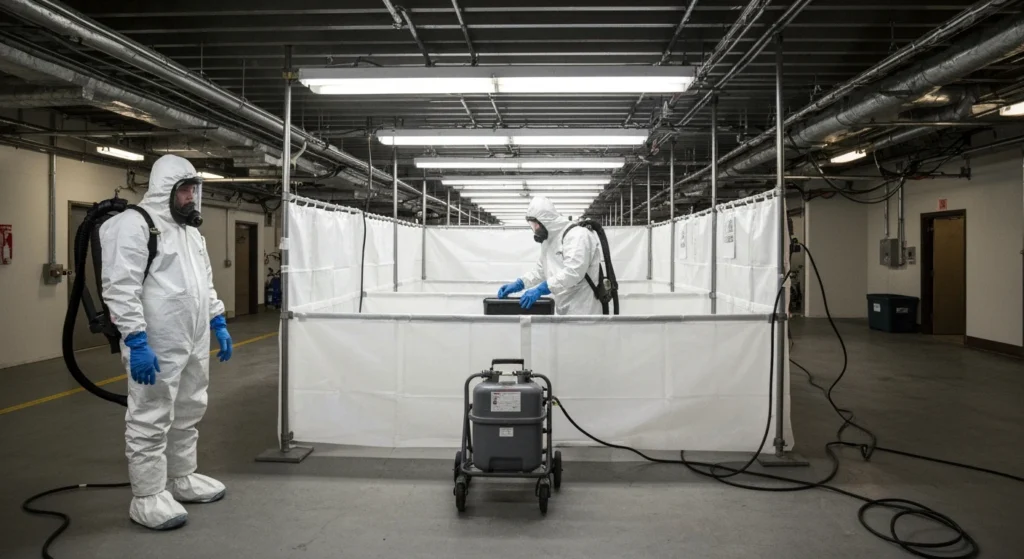
- Containment setup: Polyethylene sheeting, negative air pressure with HEPA-filtered air scrubbers, decontamination chambers
- Wet methods: Tiles are wetted with amended water before removal to suppress fiber release
- Double-bag disposal: Asbestos waste placed in labeled, sealed 6-mil poly bags and transported by licensed waste hauler to approved disposal facility
- Air clearance testing: Post-abatement air samples collected by a licensed air monitor and analyzed before containment is removed
- Waste manifests: Documentation chain from project site to approved disposal facility, retained for regulatory compliance
Asbestos Ceiling Tile Abatement Costs in NYC and Long Island
Abatement costs in the New York market depend on project scope, access conditions, and disposal requirements. General ranges:
- Single room (residential): $1,500–$4,000
- Full floor (commercial): $8,000–$30,000+
- Encapsulation (alternative to removal): $500–$2,000 per room
Encapsulation — applying a penetrating sealant that binds fibers within the tile — is an EPA-recognized alternative to removal for intact, non-friable tiles. It is significantly less expensive but does not eliminate the asbestos; it must be disclosed to future occupants and revisited if the building is renovated or demolished.
Upper Restoration provides free on-site assessments for NYC and Long Island property owners concerned about asbestos ceiling tiles. Our licensed inspectors evaluate the scope, recommend testing or abatement as appropriate, and provide written estimates with no obligation.
Frequently Asked Questions About Asbestos Ceiling Tiles
How do I know if my ceiling tiles have asbestos?
Visual clues — 9×9 or 12×12 inch tiles, fibrous texture, installation before 1980 — indicate probable asbestos content, but only PLM laboratory analysis of a physical sample can confirm it. In New York, sampling in commercial buildings must be performed by a licensed asbestos inspector. Homeowners may sample their own residence but should use professional protocols to avoid disturbing fibers.
Can I remove asbestos ceiling tiles myself?
In New York, asbestos abatement above threshold quantities must be performed by a licensed contractor under NYS ICR 56. Homeowners removing a small number of tiles from their own residence occupy a legal gray area, but the health risk is real regardless of legal status. Improper removal generates airborne fibers that can cause mesothelioma and asbestosis decades later. Professional abatement is strongly recommended.
Are asbestos ceiling tiles dangerous if left alone?
Intact, undisturbed asbestos ceiling tiles in good condition are classified as non-friable and pose minimal risk under normal conditions. The danger arises when tiles are cut, drilled, broken, or removed without proper containment. If tiles are in good condition and will not be disturbed by renovation work, encapsulation or management-in-place may be appropriate. Tiles showing deterioration should be evaluated by a licensed inspector.
What does asbestos ceiling tile removal cost in NYC?
Single-room residential abatement in the New York market typically runs $1,500–$4,000. Full-floor commercial projects range from $8,000 to $30,000 or more depending on access conditions, disposal requirements, and air monitoring scope. Encapsulation costs $500–$2,000 per room and is an EPA-recognized alternative for intact tiles not subject to disturbance.
Do I need a permit to remove asbestos ceiling tiles in NYC?
Yes. NYC Local Law 76 requires asbestos testing before any renovation or demolition work in buildings constructed before 1987. Projects above threshold quantities require NYS DOL notification at least 10 days before work begins. Work must be performed by a licensed asbestos contractor. Unpermitted asbestos removal carries significant civil penalties for property owners.
What is the difference between asbestos ceiling tiles and popcorn ceilings?
Asbestos ceiling tiles are discrete modular tiles, typically in a suspended grid system, manufactured with asbestos fiber embedded in the tile matrix. Popcorn ceilings (also called acoustic or cottage cheese ceilings) are spray-applied textured coatings applied directly to the ceiling surface — a separate product that also commonly contained asbestos through the late 1970s. Both may be present in the same building and both require testing before disturbance.
Can asbestos ceiling tiles be painted over?
Painting intact asbestos ceiling tiles is not a recommended abatement method and does not constitute legal encapsulation. Proper encapsulation requires a penetrating sealant that binds fibers within the material matrix. Simply painting over tiles may hide the issue but does not control fiber release if tiles are later disturbed. Any work on suspected asbestos ceiling tiles should be preceded by testing.