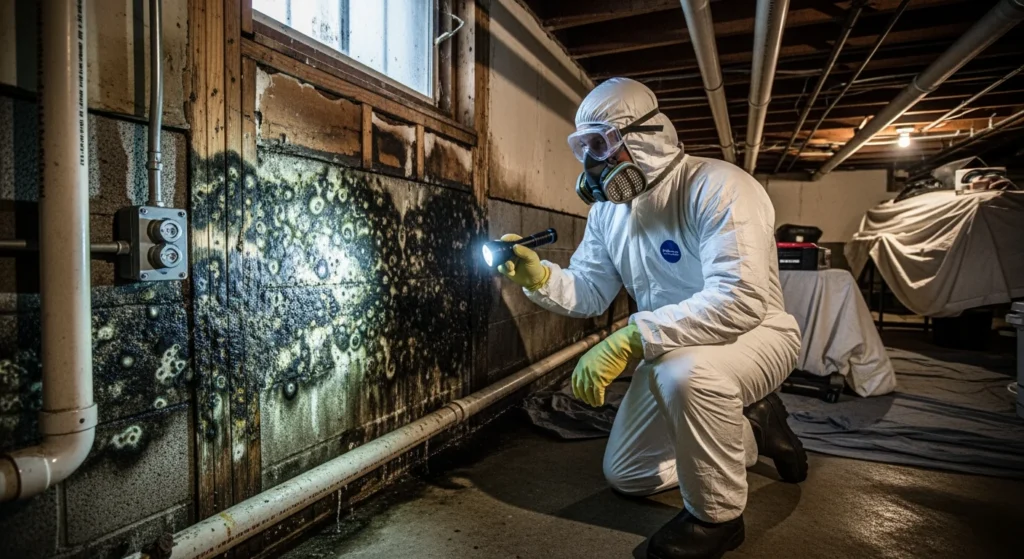
New York State’s Mold Law — codified as Article 32 of the New York Labor Law — created the licensing framework that governs all professional mold remediation in New York. Its most consequential requirement is the mandatory written work plan: before any mold remediation project of 10 square feet or more can begin, a licensed NYS DOL Mold Assessor must inspect the affected area and produce a written work plan that specifies exactly what the remediation contractor is authorized to do. The remediator cannot deviate from the work plan without assessor approval, and no mold remediation project may begin without one.
What the Work Plan Must Contain
The NYS DOL’s Article 32 regulations specify the required elements of a compliant mold remediation work plan. The plan must include: identification of the mold-affected area with boundaries; identification of the suspected mold species (or confirmation that laboratory analysis is pending); the remediation scope including what materials are to be removed versus treated in place; containment specifications including whether negative air pressure and HEPA air filtration are required; personal protective equipment (PPE) requirements for remediation workers; disposal specifications for mold-contaminated materials; and post-remediation verification (clearance testing) requirements including the standard against which clearance will be measured.
Why the Work Plan Protects Long Island Homeowners
The work plan creates a documented baseline of what the assessor determined was necessary for complete remediation. If a remediator completes the work and a clearance test fails, the work plan is the reference document that identifies whether the remediator executed the specified scope. If a remediator argues that scope creep is necessary after work begins, the work plan is the reference for what was and was not authorized in the original assessment. For insurance purposes, the work plan supports the claim scope by establishing that a licensed professional — not the restoration contractor — determined what remediation was necessary.
What Happens Without a Work Plan
A mold remediation company that performs remediation without an Article 32 work plan is operating outside the law in New York State. The DOL may impose fines on the remediator. More significantly for Long Island homeowners, insurance carriers may decline to cover mold remediation performed without Article 32 compliance documentation. Real estate attorneys representing buyers in property transactions with mold disclosure will reject un-documented remediation — a clearance letter from an unlicensed individual or a remediator who signed off their own work is not acceptable documentation for a Long Island property transaction.
Upper Restoration’s Article 32 Process
Every Upper Restoration mold project on Long Island begins with Article 32 assessment by our licensed assessors, who produce a compliant work plan before any remediation work begins. Our assessment and remediation functions operate independently, as required by law. We provide complete Article 32 documentation — work plan, remediation records, clearance test results, and assessor clearance letter — formatted for insurance claim and real estate transaction use.