Why Clearance Testing Is Non-Negotiable After Mold Remediation
Mold remediation without post-remediation verification is like surgery without a follow-up. You cannot see mold spores. You cannot confirm by visual inspection alone that remediation was thorough. The only objective way to confirm success is through post-remediation clearance testing conducted by a certified mold assessor who was not involved in the remediation work. In New York State, this separation is law. NYS Article 32 of the Labor Law requires that the entity conducting mold assessment and the entity conducting mold remediation be separate licensed companies.
What Post-Remediation Verification Involves
Visual Inspection
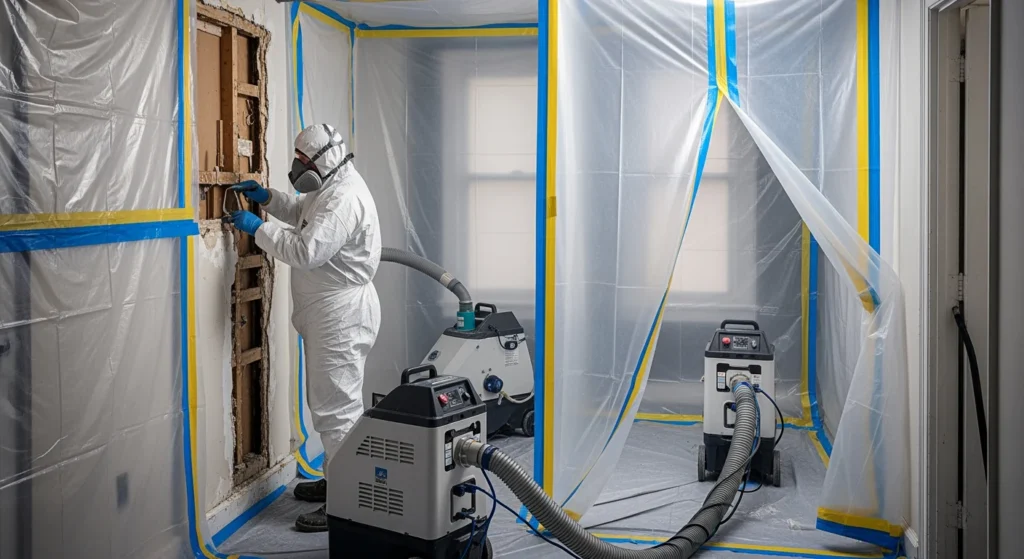
Before any sampling the assessor conducts a thorough visual inspection looking for no visible mold remaining on any surface, no remaining dust or debris from remediation, all containment properly removed, building materials visually clean, and HVAC vents and registers cleaned and clear. If the visual inspection fails, sampling does not proceed and the remediator is called back.
Air Sampling
Spore trap air samples are collected from the remediated area and from outside the building as a control baseline. Samples are analyzed by an accredited laboratory with results in 24-72 hours. A passing clearance requires that indoor spore count and species profile are comparable to or better than the outdoor baseline.
Surface Sampling When Indicated
In some cases particularly after Stachybotrys remediation or where structural wood was treated rather than removed, surface tape lift or swab samples are collected to verify surface spore levels have been reduced to acceptable levels.
What a Passing Clearance Result Looks Like
A passing clearance means indoor spore counts are at or below outdoor baseline levels, no mold species are present indoors that are absent outdoors, Stachybotrys spores are absent or at trace levels consistent with outdoor background, and visual inspection confirmed no visible mold dust or debris. If clearance fails the remediator must return to address remaining contamination at no additional charge.
Documentation You Should Receive
- Clearance report from the licensed NYS mold assessor with lab results and professional interpretation
- Laboratory certificate of analysis for all air and surface samples with accreditation documentation
- Visual inspection checklist completed by the assessor
- Chain of custody documentation for all samples collected
- Assessor license number and certification documentation
Also request from the remediator: scope of work completed, materials removed, disposal manifests for hazardous material, and their NYS license documentation. Keep all of this in your property file permanently.
Questions to Ask at the Final Walkthrough
- Did the visual inspection pass? Can you document that in writing?
- How many air samples were taken and from which locations?
- How long will lab results take and how will they be delivered?
- If the air clearance fails, who re-tests and at whose cost?
- What specific clearance criteria are you using such as IICRC S520 or state protocol?
- When can we safely re-occupy the remediated space?
FAQ
Is post-remediation clearance testing required in New York?
Under NYS Article 32 the mold assessment and remediation must be performed by separate licensed entities, which effectively requires independent post-remediation verification. IICRC S520 standards used by licensed NYS remediators also require post-remediation verification before work is considered complete.
How much does mold clearance testing cost on Long Island?
Post-remediation clearance testing by a certified NYS mold assessor typically costs $300-$600 for a standard residential project in Nassau or Suffolk County depending on the number of samples required. This is separate from the remediation cost.
What if my mold clearance testing fails?
If clearance fails the remediator must return and address the deficiency at no additional cost. This should be explicitly stated in your remediation contract before work begins. A second clearance test will then be required.
Upper Restoration: From Remediation to Clearance
Upper Restoration provides certified mold remediation in compliance with NYS Article 32 requirements and coordinates with independent licensed mold assessors for post-remediation clearance testing. We provide complete documentation packages for insurance, real estate, and regulatory purposes. Serving Nassau County, Suffolk County, and NYC. Contact us for an assessment.