The Immediate Impact of Restaurant Sewage Backups in NYC
For a restaurant owner in Manhattan, Brooklyn, or Queens, few sights are more distressing than dark, foul-smelling water bubbling up through floor drains in the middle of a dinner rush. A restaurant sewage backup nyc is not merely a plumbing inconvenience; it is a high-stakes emergency that triggers immediate regulatory consequences. Under NYC Health Code Article 81, any backup of sewage into a food service establishment requires the immediate cessation of operations. There is no middle ground—if sewage is present, the facility must close until the hazard is remediated and the Department of Health and Mental Hygiene (DOHMH) authorizes a reopening.
Sewage is classified as Category 3 water, or “black water,” by the IICRC S500 Standard for Professional Water Damage Restoration. This means the liquid contains significant pathogenic agents, including bacteria, viruses, and parasites such as E. coli, Norovirus, and Hepatitis A. In the densely packed infrastructure of New York City, these backups are often caused by aging municipal sewer lines, heavy rainfall overwhelming combined sewer systems, or internal blockages. When this occurs, the primary goal is to mitigate the risk to public health while minimizing the duration of the business shutdown.
The financial impact of a backup extends far beyond the cost of cleanup. A single day of closure for a high-volume restaurant in Midtown or the Financial District can result in tens of thousands of dollars in lost revenue. Furthermore, the loss of perishable inventory and the potential damage to expensive Point of Sale (POS) systems, low-level refrigeration units, and custom cabinetry can quickly escalate the total claim value. Working with a specialized firm like Upper Restoration ensures that the cleanup meets both industry standards and local regulatory requirements, paving the way for a successful inspection and dohmh reopening.
Regulatory Requirements and the DOHMH Inspection Process
The NYC Department of Health and Mental Hygiene (DOHMH) views sewage backups as a “public health hazard.” When a backup occurs, the restaurant is often “self-closed” or closed by an inspector. To reopen, the operator must demonstrate that the source of the backup has been corrected and that the entire affected area has been cleaned and sanitized according to food service sanitation standards. This process is rigorous and leaves little room for error.
Inspectors will look for any signs of residual moisture or “sewage solids” in hard-to-reach areas, such as under walk-in coolers, behind baseboards, or within floor cracks. They also evaluate the potential for cross-contamination. If sewage backed up in the basement prep area, the inspector may question the safety of food stored in upstairs dining areas. Documentation is your strongest tool during this phase. Having a detailed “Certificate of Completion” from an IICRC-certified firm, along with logs of the sanitization agents used, can significantly expedite the dohmh reopening process.
Preparing for a Re-Inspection
To pass a DOHMH re-inspection after a restaurant sewage backup nyc, the facility must meet the following criteria:
- Source Correction: Documentation from a licensed plumber or the DEP (Department of Environmental Protection) stating that the sewer line is clear and functioning.
- Surface Sanitization: All non-porous surfaces (stainless steel, tile, plastic) must be cleaned with a detergent and then sanitized with a solution of at least 100ppm chlorine or an equivalent EPA-registered disinfectant.
- Porous Material Removal: Any porous materials (drywall, unsealed wood, cardboard packaging) that came into contact with sewage must be removed and disposed of. These materials cannot be effectively “cleaned” of Category 3 pathogens.
- Equipment Verification: Verification that floor-mounted equipment has been moved, cleaned underneath, and re-leveled.
- ATP Testing: While not always mandated by the DOHMH, many proactive owners use ATP (Adenosine Triphosphate) testing to provide objective proof of cleanliness.
Professional Biohazard Remediation Protocols (IICRC S500)
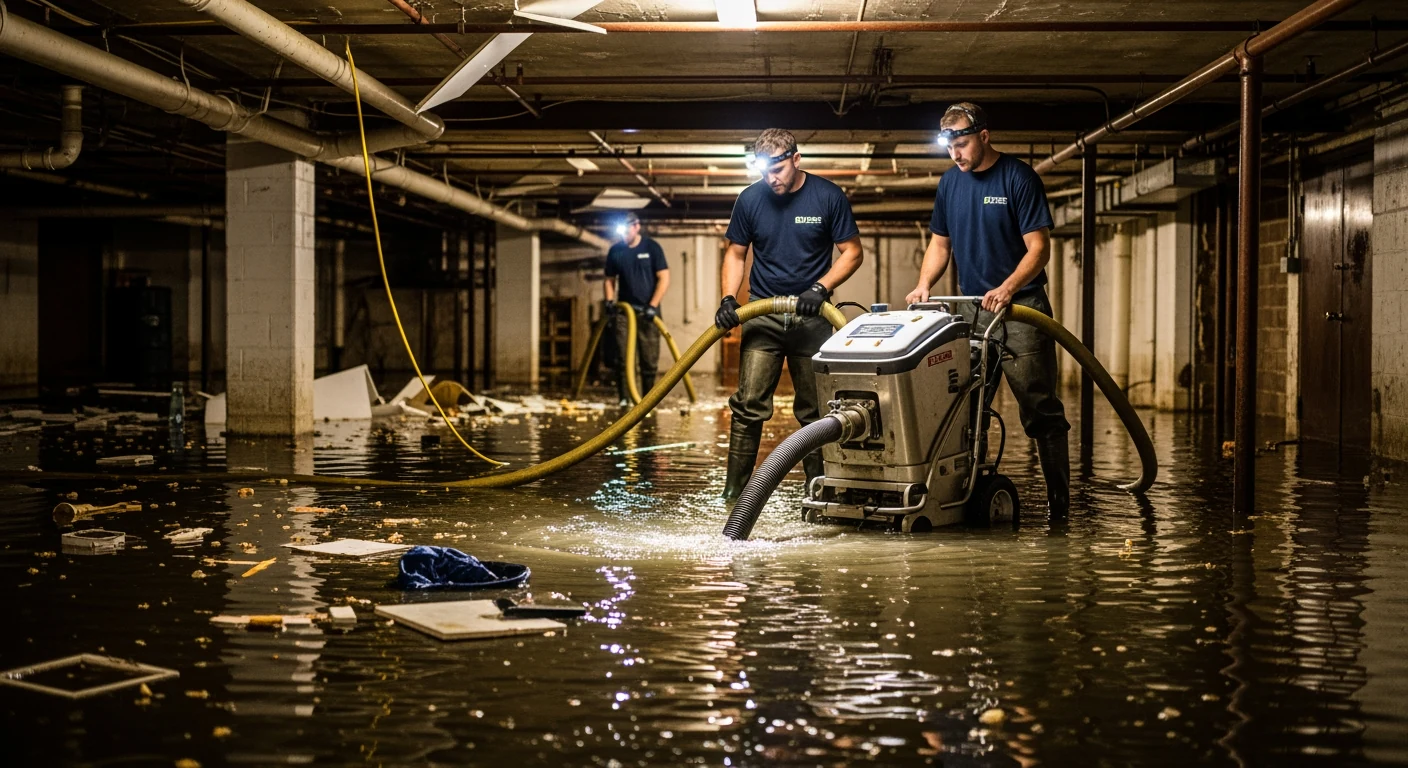
When Upper Restoration arrives at a commercial kitchen, the process follows the IICRC S500 and S520 standards for restaurant biohazard cleanup. Unlike a standard water leak, sewage requires specialized personal protective equipment (PPE) and containment strategies to prevent the aerosolization of pathogens. In the tight confines of a West Village bistro or a Bronx commercial bakery, containment is critical to ensuring that the cleanup in the basement doesn’t contaminate the service area upstairs.
The first step is the extraction of bulk sewage. This is performed using HEPA-filtered vacuum systems that prevent the release of airborne contaminants. Once the bulk liquid is removed, the “controlled demolition” phase begins. In a commercial environment, this often involves removing the bottom 12 to 24 inches of drywall (if present) and any saturated insulation. In many NYC restaurants, where “quarry tile” is the standard flooring, the focus shifts to the grout lines. Sewage can seep into porous grout, requiring specialized scrubbing with high-pH detergents to break down organic proteins.
After cleaning, an EPA-registered broad-spectrum disinfectant is applied. This is not a simple “wipe down.” The disinfectant must remain in contact with the surface for a specific “dwell time” (often 10 minutes) to ensure the total destruction of pathogens like Norovirus, which is notoriously resistant to standard cleaning agents. For commercial sewage cleanup nyc, Upper Restoration technicians also focus on the “low-zone” electronics. This includes the power strips, networking cables for the POS system, and compressor coils for reach-in refrigerators that sit at floor level and are frequently submerged during a backup.
“The standard for a restaurant cleanup isn’t just ‘visually clean.’ It’s ‘microbiologically safe.’ If you miss a single pocket of organic matter under a prep table, you’re not just risking a failed inspection; you’re risking a foodborne illness outbreak.”
Addressing Restaurant Grease Trap Sewage and Plumbing Failures
A significant portion of sewage incidents in the food service industry involves restaurant grease trap sewage. Grease traps (or interceptors) are designed to capture Fats, Oils, and Grease (FOG) before they enter the city’s sewer system. However, if these traps are not maintained according to DEP Article 75 regulations, they can become completely obstructed. When a grease trap fails, the resulting backup is a mixture of raw sewage and rancid food grease—a combination that is exceptionally difficult to clean and creates an intense, lingering odor.
In Nassau and Suffolk County, where many restaurants rely on septic systems or older grease interceptors, these backups can also saturate the surrounding soil if the leak occurs outside the building. Within the restaurant, grease-laden sewage acts as an adhesive, sticking to equipment legs and floor drains. This requires the use of degreasers in tandem with disinfectants. Upper Restoration’s approach to restaurant grease trap sewage includes mechanical cleaning of the affected floor drains to ensure that residual grease does not cause a secondary backup immediately after the restaurant reopens.
Furthermore, NYC’s DEP frequently issues fines to restaurants that do not have properly sized or maintained grease interceptors. During the remediation process, it is an opportune time for owners to verify their compliance with the DEP’s “Best Management Practices” for FOG. Resolving the underlying plumbing issue is the only way to prevent the recurring cycle of backups that can eventually lead to the permanent revocation of a food service permit.
Navigating Insurance Claims and Business Interruption
Recovering from a restaurant sewage backup nyc involves more than just physical labor; it involves complex financial negotiations. Most commercial property insurance policies include “Sewer Backup” coverage as an endorsement, but the limits can vary significantly. Some policies may cap sewage cleanup at $10,000 or $25,000, which may not be sufficient for a large-scale commercial sewage cleanup nyc involving significant structural drying and inventory loss.
Business Interruption (BI) insurance is the most critical component for a restaurant owner. BI coverage is designed to replace lost net income and cover fixed expenses (like rent and payroll) during the “period of restoration.” However, insurance adjusters will often scrutinize the “due diligence” of the owner. If the backup was caused by a known grease trap issue that the owner failed to fix, the carrier might attempt to deny the claim based on “failure to maintain.”
Upper Restoration assists in this process by providing the detailed documentation adjusters require. This includes moisture maps, photo documentation of the “before and after” states, and an itemized list of affected materials. We also coordinate with the restaurant’s POS provider to pull sales reports that help establish the historical revenue needed to calculate a Business Interruption claim. In the competitive NYC market, having a clear paper trail is the difference between a fully funded recovery and a devastating out-of-pocket expense.
Commonly Overlooked Costs in Sewage Claims
- Food Spoilage: Not just the food touched by sewage, but food that sat in walk-ins that lost power or were contaminated by airborne odors.
- Professional Re-Sanitization: The cost of the final “deep clean” required for food service sanitation before food prep can resume.
- Mandatory Upgrades: If an inspector requires a new grease trap or floor drain system to be installed to meet current codes during the repair.
- Marketing and PR: The cost of “grand reopening” efforts to win back customers who may have heard about the closure.
Frequently Asked Questions
How long does it take to reopen after a sewage backup?
In most cases, the physical cleanup and drying process takes 24 to 72 hours. However, the timeline for a dohmh reopening depends on the availability of a health inspector. Generally, a restaurant can expect to be closed for 3 to 7 days, depending on the severity of the damage and the speed of the regulatory response.
Can my staff perform the sewage cleanup?
It is strongly discouraged. Restaurant biohazard cleanup involves exposure to pathogens that require OSHA-mandated training and specific PPE. Furthermore, untrained staff often use bleach, which can react with other chemicals or simply mask the problem without properly removing the organic load. Professional remediation provides the documentation needed to satisfy health inspectors and insurance adjusters.
Does insurance cover the loss of all food in the kitchen?
Usually, yes, under a “Food Spoilage” endorsement. However, the food must be inventoried and photographed before disposal. Do not throw away affected stock until you have consulted with your adjuster or restoration contractor, as this evidence is vital for your claim.
Will a sewage backup leave a permanent smell?
If handled correctly, no. Odors in sewage backups are caused by volatile organic compounds (VOCs) produced by bacteria. By removing the source (the sewage), cleaning the area with antimicrobial agents, and using industrial air scrubbers with charcoal filters, Upper Restoration can return the restaurant to a neutral-smelling state.
What is the most common cause of backups in NYC restaurants?
While municipal line breaks occur, the most common “internal” cause is the accumulation of grease in the lines or the flushing of non-flushable items (like wet wipes) into the system by customers. Regular “hydro-jetting” of the kitchen lines is the best preventive measure.
Talk to Upper Restoration
If your restaurant is currently facing a closure due to a sewage emergency, timing is your most valuable asset. The longer sewage sits, the deeper pathogens penetrate into the building’s structure, and the longer your doors remain closed to the public. Upper Restoration provides 24/7 emergency response for restaurant sewage backup nyc across all five boroughs, as well as Nassau and Suffolk County.
Our team is specifically trained in the nuances of NYC commercial property restoration, from navigating the logistical challenges of a basement kitchen in Greenwich Village to meeting the strict sanitation requirements of the DOHMH. We don’t just clean the floor; we help you manage the entire process, from the first extraction to the final insurance settlement. We understand that in the New York restaurant world, your reputation is everything. We work quietly, efficiently, and professionally to get your kitchen back to food service sanitation standards so you can focus on your guests.
Contact Upper Restoration today for a professional assessment of your facility. We will provide a clear, IICRC-compliant plan of action to resolve the biohazard, satisfy the regulators, and get your team back to work.