Asbestos Abatement in Suffolk County, NY: A Complete Guide for Homeowners and Contractors (2026)
Asbestos abatement in Suffolk County is as routine as in Nassau — perhaps more geographically varied given the county’s span from dense suburban Babylon and Islip through Brookhaven’s diverse landscapes to the East End’s historic and high-value properties, but governed by the same NYS Code Rule 56 requirements and performed under the same NYSDOL licensing framework. Suffolk County’s median home construction year of 1970 includes a substantial proportion of pre-1980 housing across all townships, and the range of asbestos-containing materials in that stock spans from the 9×9 floor tiles of western Suffolk’s Cape Cods to the original pipe insulation and plaster of pre-war East End cottages.
Code Rule 56 and Abatement Requirements in Suffolk County
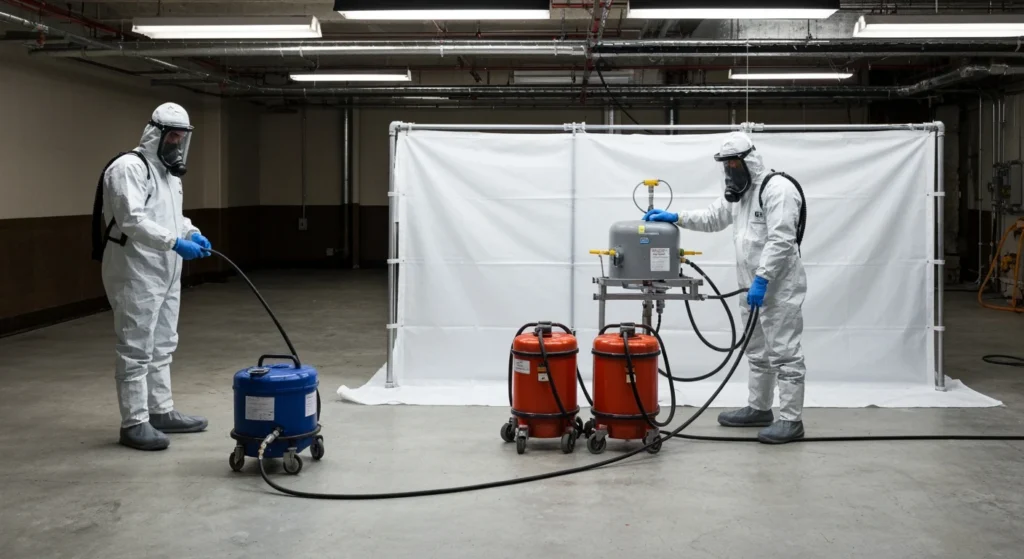
NYS Code Rule 56 applies throughout Suffolk County exactly as in Nassau County. Pre-demolition asbestos surveys are required before renovation or demolition in pre-1980 structures. Licensed abatement must precede any disturbing of confirmed ACMs. NYSDOL-licensed contractors, proper containment, negative air pressure, HEPA filtration, air monitoring, and licensed waste disposal are all mandatory components of a compliant abatement project in Suffolk County.
Suffolk County’s building permit process for significant renovations typically requires documentation of asbestos survey completion before permits are issued — another regulatory touchpoint that enforces the survey requirement independently of NYSDOL enforcement.
Suffolk County-Specific ACM Patterns
Western Suffolk (Babylon, Islip, Amityville, Bay Shore) has the same post-war housing ACM profile as Nassau County — floor tiles, pipe insulation, joint compound, popcorn ceilings — concentrated in homes built from the late 1940s through the 1970s.
Mid-Suffolk (Brentwood, Central Islip, Hauppauge, Smithtown) has a 1960s–1970s concentration. A notable issue in this zone: many 1970s-era homes in Smithtown and Hauppauge have aluminum wiring in branch circuits alongside asbestos joint compound in the drywall — renovation projects that address the electrical system often simultaneously trigger the asbestos survey requirement for the walls being opened.
North Shore Suffolk (Huntington, Cold Spring Harbor, Northport) has older estate-era and pre-war construction that may contain ACMs not typical in post-war suburban stock: plaster with asbestos reinforcing fiber, vermiculite insulation in attics (commonly contaminated with tremolite asbestos from Libby, Montana), and original boiler and pipe insulation with higher asbestos content than later materials. Vermiculite attic insulation is a particular concern in North Shore older properties — it must not be disturbed without testing.
East End (Southampton, East Hampton, Riverhead, North Fork) has pre-war construction with the broadest range of potential ACMs on Long Island. Pre-demolition surveys for East End renovation projects in pre-1980 structures should scope for a wider range of materials and collect more samples than surveys for standard post-war suburban construction.
Asbestos Abatement Costs in Suffolk County (2026)
Floor tile abatement: $2,500–$6,000 for standard residential scope. Pipe insulation: $25–$50 per linear foot. Popcorn ceiling: $3–$7 per square foot. Pre-demolition survey: $350–$700 for western or mid-Suffolk; $700–$1,800 for East End pre-war properties. Post-abatement air clearance: $250–$500 per area. East End abatement projects typically run 15–25 percent above these ranges due to trade availability and access considerations.
See our complete asbestos abatement guide for the full cost matrix and detailed scope descriptions for each material type.