Asbestos Abatement in Nassau County, NY: What Homeowners Need to Know Before Any Renovation (2026)
Asbestos abatement is one of the most routine professional services in Nassau County’s pre-1980 housing stock — routine because the county’s median home construction year of 1955 places the majority of its 482,000 housing units squarely within the era when asbestos-containing materials were standard in residential construction. Floor tiles, pipe insulation, joint compound, duct wrap, textured ceilings — these materials are present in Nassau County homes at rates that make asbestos survey and, when necessary, abatement a standard precondition to any significant renovation or demolition.
This guide covers the legal requirements, common materials, contractor licensing requirements, and 2026 cost benchmarks for asbestos abatement in Nassau County.
NYS Code Rule 56: The Abatement Requirement in Nassau County
New York State Code Rule 56 (12 NYCRR Part 56) requires that before any demolition or renovation in a building built before 1980, a pre-demolition asbestos survey must be completed by a NYS-certified asbestos inspector. If asbestos-containing materials (ACMs) are confirmed in the area of planned work, licensed abatement must be completed before demolition proceeds.
For Nassau County homeowners, this means: kitchen renovation that involves demolishing original tile floors or walls — survey required. Bathroom remodel disturbing pre-1978 drywall with joint compound — survey required. Basement finishing that involves disturbing pipe insulation or original floor tiles — survey required. The survey requirement applies regardless of whether the contractor thinks asbestos is present; the survey is what establishes the presence or absence of ACMs, not the contractor’s visual judgment.
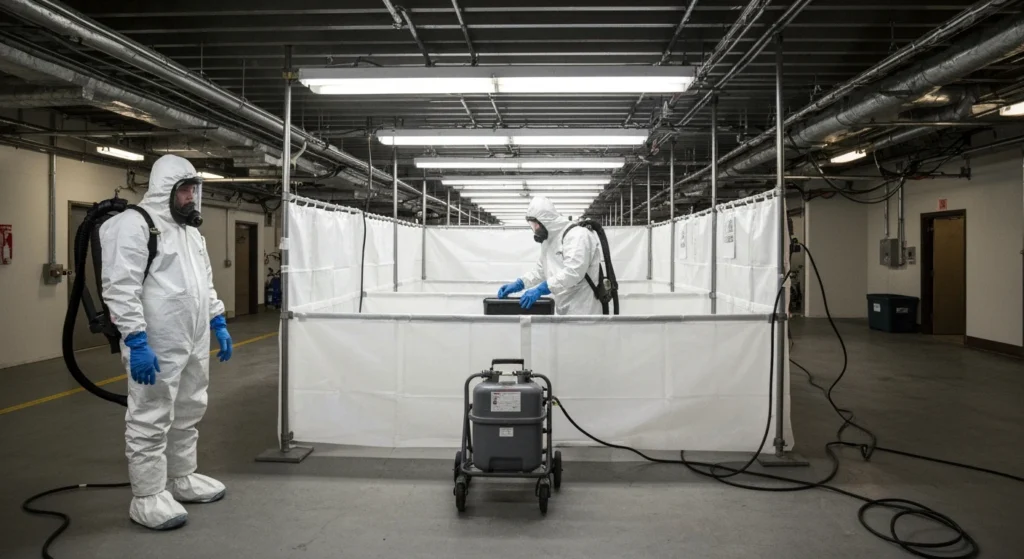
Abatement contractors in Nassau County must hold a valid NYS DOL asbestos contractor license. Individual supervisors must hold a supervisor certificate; workers must hold worker certificates. The abatement must occur under containment with negative air pressure and HEPA filtration, with air monitoring during and after abatement to confirm fiber levels have been reduced to clearance standards. Abatement waste is regulated material — it must be properly containerized, labeled, and transported to a permitted disposal facility.
Common ACMs in Nassau County’s Pre-1980 Housing Stock
The most frequently encountered ACMs in Nassau County residential abatement projects, based on field experience in the county’s Cape Cods, ranches, and split-levels:
9×9 and 12×12 vinyl composite floor tiles (VCT) with black mastic adhesive are present in the majority of pre-1975 Nassau County homes. The tiles and the adhesive both frequently contain chrysotile asbestos. Intact tiles in good condition do not require immediate abatement but must be abated before any flooring removal. Cracked, broken, or deteriorating tiles with exposed adhesive are friable and require prompt attention.
Pipe insulation on heating system lines in basements — particularly the tan or gray wrap on hot water lines, the corrugated insulation on furnace connections, and elbow insulation at fittings — commonly tests positive in pre-1975 systems. This material is frequently friable when dry and poses elevated fiber release risk when disturbed without containment.
Joint compound in pre-1978 drywall construction is one of the most commonly missed ACMs. It is invisible behind painted surfaces, present throughout the home wherever drywall was finished, and is released as a fine dust when walls are drilled, sanded, or demolished. Every wall demolition project in a Nassau County home built between 1950 and 1978 should be preceded by joint compound sampling.
Popcorn (acoustic spray) ceiling texture applied before 1977 frequently contains chrysotile asbestos at concentrations that require abatement before any ceiling disturbance. Given the prevalence of popcorn ceilings in Nassau County’s 1960s and 1970s ranches and Colonials, this is one of the highest-volume abatement projects in the county.
Asbestos Abatement Costs in Nassau County (2026)
Floor tile abatement (basement, kitchen, or bathroom — up to 300 sq ft): $2,500–$6,000. Larger floor tile projects: $8–$20 per square foot depending on access and tile condition. Pipe insulation abatement: $25–$50 per linear foot. Popcorn ceiling abatement: $3–$7 per square foot. Joint compound abatement (wall demolition scope): varies by project — typically $2,000–$8,000 for a single room.
Full pre-renovation asbestos survey and testing: $350–$700. Post-abatement air clearance testing: $250–$500 per area. See our asbestos abatement Long Island guide for the complete cost matrix.