Why Attic Mold Is So Common on Long Island and in NYC
Attic mold is among the most frequent remediation projects in the New York metro area — and it’s almost entirely preventable. The building stock of Long Island and NYC creates near-ideal conditions for attic mold development: post-war Cape Cods and colonials with unvented or under-vented attic assemblies, bathroom exhaust fans that terminate in attic space instead of outside, and heated living spaces that push warm, humid air upward through ceiling penetrations.
When that warm, moist air meets the cold underside of roof sheathing in winter, condensation forms. Do that repeatedly across a heating season and you have the moisture accumulation that Cladosporium, Penicillium, and Aspergillus need to colonize roof decking and rafters.
The Five Most Common Causes of Attic Mold in NYC and Long Island
1. Bathroom and Kitchen Exhaust Fans Venting Into the Attic
The single most common cause of attic mold in Long Island homes. Building codes require exhaust fans to terminate outside the building envelope — but in millions of post-war homes, the flex duct simply terminates in the attic space, dumping warm, humid air directly onto the cold roof sheathing. A single improperly vented bathroom fan running 20 minutes a day introduces enough moisture to produce mold growth within one to two heating seasons.
Inspection check: look for flexible duct that terminates at a louvered vent cap penetrating the roof or a gable wall. If the duct just ends in the attic with no exterior termination, the fan is venting into the attic.
2. Insufficient Attic Ventilation
The U.S. Department of Housing and Urban Development recommends a minimum of 1 square foot of net free ventilation area per 150 square feet of attic floor space — or 1:300 with a vapor retarder. Many Long Island homes built from the 1940s through the 1960s were constructed before modern ventilation standards and have inadequate soffit and ridge vent combinations. Without proper air movement across the attic floor, moisture stratifies and accumulates at the roof deck.
3. Air Leakage From Living Space Below
Warm air from the living space below rises into the attic through ceiling penetrations — recessed lights, attic hatches, plumbing chases, HVAC duct penetrations, and electrical boxes. Each penetration is a pathway for moisture-laden air to enter the attic assembly. In NYC row houses and attached homes, party wall penetrations compound the problem. Air sealing at the ceiling plane is the permanent fix; it is often skipped because it requires attic access and is not visible to the homeowner.
4. Ice Damming
A problem specific to cold-climate markets like New York. Ice dams form at roof eaves when heat escaping from the living space melts snow on the upper roof; the meltwater runs down to the cold eave overhang and refreezes, creating an ice dam that forces water back under shingles. Repeated ice dam events over several winters saturate roof sheathing and framing, creating persistent moisture conditions that produce mold. Ice damming is fundamentally a ventilation and insulation problem — not a roofing problem.
5. Roof Leaks and Flashing Failures
Roof leaks around chimneys, skylights, valleys, and penetrations introduce liquid water directly into the attic assembly. Even small, slow leaks that don’t produce visible ceiling staining can saturate roof decking over time. Flashing failures are particularly common around NYC brownstone roof parapets and Long Island chimney flashings, which are subject to freeze-thaw cycling and often receive deferred maintenance.
How to Identify Attic Mold
Attic mold is typically identified during:
- Home inspection before a property sale (the most common discovery point)
- Roofing contractor assessment during repair or replacement
- Proactive inspection after a water event or persistent musty odor in upper floors
Visual indicators of attic mold:
- Dark staining on roof sheathing — black, grey, or greenish discoloration following the grain of the wood
- Fuzzy or powdery growth on rafters, ridge board, or collar ties
- White or grey streaking on OSB roof decking (Cladosporium staining)
- Cupping or buckling of roof sheathing from repeated wetting and drying cycles
- Condensation or frost on the underside of the roof deck in winter
Attic Mold Species Common in New York
| Species | Appearance | Risk Level | Notes |
|---|---|---|---|
| Cladosporium | Olive-green to black, powdery | Low-moderate | Most common attic mold in NY |
| Penicillium / Aspergillus | Blue-green, white, or yellow | Moderate | Often co-occur, HVAC risk |
| Stachybotrys (black mold) | Slimy black, wet appearance | High | Requires sustained moisture — less common in attics |
| Serpula lacrymans (dry rot) | Reddish-brown, wood-decaying | High (structural) | Structural damage concern |
Does Attic Mold Affect Indoor Air Quality?
This is the most important question homeowners ask — and the answer is nuanced. In most cases, attic mold does not significantly affect indoor air quality because the attic is separated from the living space by the ceiling assembly. Spores in the attic are not readily drawn into the living space under normal pressure relationships.
The exceptions matter:
- Attic hatches that are not properly sealed allow direct air exchange
- HVAC air handlers located in the attic (common in Long Island homes) can draw attic air through leaky duct connections into the distribution system
- Extensive growth with active sporulation — large areas of black mold — can produce spore concentrations high enough to migrate downward
From a health standpoint, attic mold is primarily a structural and property-value concern. From a practical standpoint, it becomes a crisis at the point of property sale — most NYC-area home inspectors flag any visible attic mold, and lenders increasingly require remediation before closing.
Attic Mold Remediation: What the Process Involves
Licensed attic mold remediation in New York follows a defined sequence:
- Assessment and sampling: Licensed mold assessor inspects the attic, documents affected areas, takes air and surface samples, identifies the moisture source, and writes a remediation plan.
- Source correction: Before any remediation work begins, the moisture source must be addressed — exhaust fans rerouted to exterior, ventilation improved, roof leaks repaired. Remediation without source correction will result in recurrence.
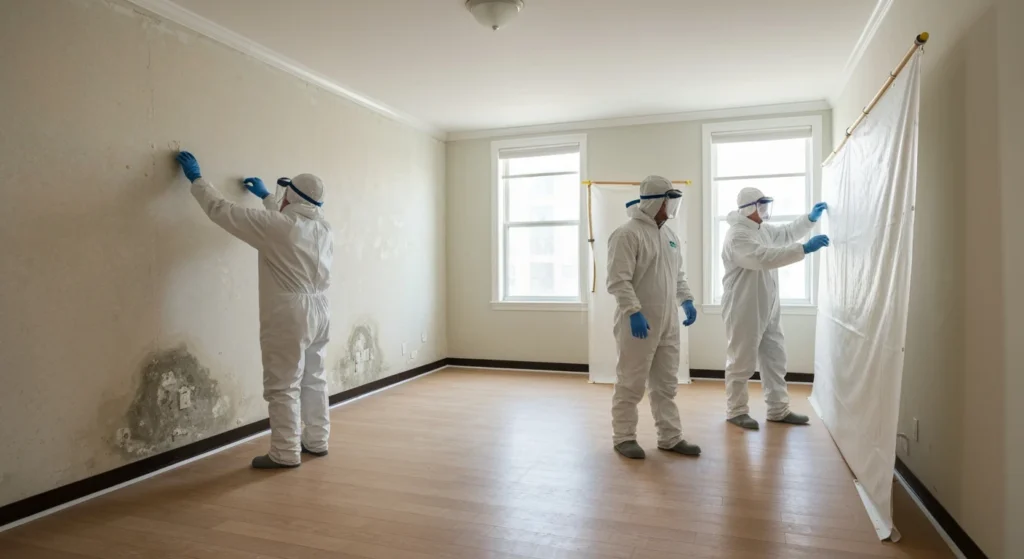
- Containment: For projects above 10 square feet, the attic access point is contained to prevent spores from entering the living space during remediation.
- HEPA vacuuming: Loose spores and debris are removed from affected surfaces using HEPA-filtered vacuums before any treatment is applied.
- Mechanical removal or treatment: Affected roof decking and framing are wire-brushed or sanded to remove surface mold growth, followed by application of an EPA-registered antimicrobial solution. Severely damaged sheathing may require replacement.
- Encapsulation: A mold-resistant sealant is applied to treated surfaces, encapsulating any residual staining and preventing regrowth.
- Clearance testing: Post-remediation air sampling by the licensed assessor confirms spore levels have returned to acceptable ranges.
Attic Mold Remediation Cost on Long Island and in NYC
| Scope | NYC / LI Cost Range | Notes |
|---|---|---|
| Small affected area (<100 sq ft) | $2,500–$5,000 | Treatment + encapsulation |
| Moderate (100–300 sq ft decking) | $5,000–$10,000 | Most common Long Island scope |
| Extensive (full attic) | $10,000–$20,000 | Structural members affected |
| Sheathing replacement included | Add $3,000–$8,000 | When decking is beyond treatment |
| Ventilation correction | $1,500–$4,000 | Separate from remediation cost |
Attic remediation always requires ventilation source correction as a separate scope. Budget for both when planning the total project cost.
Upper Restoration provides licensed attic mold assessment and remediation across Long Island and NYC. Our assessors identify the moisture source, produce the required NYS Chapter 32 remediation plan, and coordinate licensed remediation with post-clearance testing — handling the full process from discovery through reoccupancy sign-off.
Frequently Asked Questions About Attic Mold
How serious is mold in the attic?
Attic mold is primarily a structural and property-value concern rather than an immediate health risk. In most cases it does not significantly affect indoor air quality because the attic is separated from living space. However, it becomes critical at the point of property sale — inspectors flag it universally, and lenders often require remediation before closing. Structurally, untreated attic mold can deteriorate roof sheathing and framing over time.
What causes mold in the attic of a Long Island home?
The most common cause in Long Island post-war homes is bathroom or kitchen exhaust fans that vent into attic space instead of outside. Second most common is inadequate attic ventilation — insufficient soffit-to-ridge airflow. Other causes include air leakage from living space through ceiling penetrations, ice damming that forces water under shingles, and roof or flashing leaks. Addressing the moisture source is mandatory before any remediation will hold.
Can I paint over attic mold?
No. Painting over mold does not kill it or stop growth — mold will continue to grow beneath paint and eventually push through. Effective treatment requires mechanical removal of surface mold growth followed by application of an EPA-registered antimicrobial solution and then encapsulation with a mold-resistant sealant. Painting is not a substitute for any of these steps and is not an accepted remediation method under NYS Chapter 32.
How much does attic mold remediation cost?
Attic mold remediation on Long Island and in NYC typically costs $2,500–$5,000 for small affected areas under 100 square feet, $5,000–$10,000 for moderate growth across 100–300 square feet of roof decking — the most common Long Island scope — and $10,000–$20,000 for extensive full-attic projects. Ventilation correction to address the moisture source adds $1,500–$4,000 as a separate cost.
Does attic mold need to be disclosed when selling a home in New York?
Yes. New York State’s Property Condition Disclosure Act requires sellers to disclose known material defects, including mold. Attic mold discovered during a buyer’s inspection — and not disclosed by the seller — creates significant legal exposure. Remediation before listing eliminates the disclosure obligation and avoids deal-threatening inspection findings. Upper Restoration can typically complete attic mold remediation and clearance testing within 2–3 weeks of initial assessment.
Will insurance cover attic mold remediation?
Standard homeowners insurance rarely covers attic mold because it typically results from long-term ventilation deficiencies rather than a sudden covered event. If attic mold results from a covered roof leak — a storm event, for example — the resulting mold remediation may be included in the water damage claim. Mold sublimits of $5,000–$10,000 apply in many policies even for covered causes. Review your policy declarations page and consult with a public adjuster if your claim is related to a covered water event.