Lead paint in a New York City co-op or condo creates a unique web of obligations – because responsibility is split between the unit owner, the building (co-op corporation or condo association), and in some cases the managing agent. Understanding who is responsible for what is essential before any renovation, during a sale, or when a tenant or child is affected. Here’s the 2026 guide.
Who Is Responsible for Lead Paint in an NYC Co-op?
In a co-op, the co-op corporation owns the building; shareholders own a proprietary lease for their unit. Lead paint responsibility is governed by the proprietary lease and Local Law 1. Generally:
- Common areas: The co-op corporation (building) is responsible for lead paint hazards in hallways, stairwells, lobbies, and other common areas
- Within the unit: The shareholder is responsible for lead paint within the four walls of their apartment – walls, ceilings, windows, doors, and woodwork
- Between floors/walls: Shared structural elements (pipes, beams) fall in a gray area usually governed by the proprietary lease’s maintenance responsibility provisions
In a condo, the unit owner owns their unit outright, and the condo association is responsible for common areas. The breakdown is similar to co-ops, but governed by the condo’s Declaration and By-Laws rather than a proprietary lease.
NYC Local Law 1: Annual Inspection Requirements
NYC Local Law 1 (the Childhood Lead Poisoning Prevention Act) applies to owners of residential buildings built before 1960 – and buildings built before 1978 where a child under 6 resides. For co-ops and condos, this means:
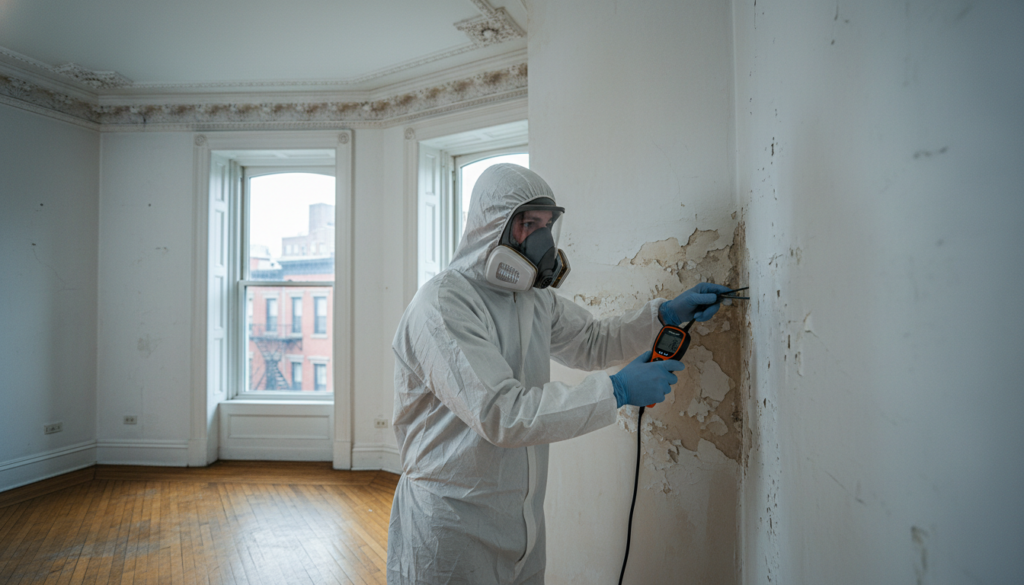
- Annual visual inspection of each unit where a child under 6 resides, looking for deteriorated lead paint
- Inspection of common areas annually
- Prompt remediation of any deteriorated lead paint found (using safe work practices or by a certified contractor)
- Turnover inspection when a unit changes occupants
- Maintenance of inspection records for at least 10 years
Boards and managing agents are responsible for implementing the Local Law 1 program for common areas; unit owners bear responsibility within their own apartments.
Board Approval Before Lead Abatement Work
Co-op and condo boards typically require alteration agreement approval before any lead abatement work that involves opening walls, disturbing structure, or using contractors in the building. The process generally requires: submission of contractor credentials and proof of NYC DEP or EPA RRP certification, a work plan and schedule, certificate of insurance naming the building as additionally insured, and a deposit for potential building damage. Allow 2-4 weeks for board approval on top of the abatement project timeline.
Lead Paint and NYC Real Estate Transactions
Federal law (TSCA Section 1018) requires sellers of pre-1978 residential properties to disclose known lead paint hazards to buyers and provide the EPA’s lead paint pamphlet. Buyers have a 10-day inspection period. In NYC, this disclosure is standard in the contract of sale. Key points for co-op and condo transactions:
- The seller discloses what they know – there’s no requirement to test before selling
- Buyers can include a lead paint inspection contingency in the purchase offer
- FHA and VA loans require remediation of deteriorated lead paint before closing
- The building’s LL1 inspection records are relevant due diligence for buyers – request them through the managing agent
What Lead Abatement Costs in an NYC Co-op or Condo
Lead abatement costs in NYC are higher than national averages due to DEP filing requirements, air monitoring, and urban site logistics. Typical ranges for co-op/condo unit work: single room encapsulation ,500-,000, full apartment encapsulation ,000-,000, full apartment removal ,000-,000. Common area corridor work is typically billed to the building’s capital budget and assessed to shareholders/owners through maintenance charges or special assessments.
Frequently Asked Questions
Can a co-op board require a shareholder to remove lead paint?
A co-op board can require shareholder compliance with Local Law 1 obligations for their unit, and can include lead paint remediation as a condition of an alteration agreement. Boards cannot typically compel shareholders to remediate lead paint in good condition that poses no immediate hazard – but deteriorated paint creating a hazard is within the board’s authority to require action on.
What if a child tests positive for lead poisoning in my building?
NYC Health Department will conduct an environmental investigation of the child’s home and, if lead paint is found to be a likely source, issue a violation order requiring remediation within a specific timeframe. Building owners face significant fines for non-compliance. The Health Department’s investigation may also examine common areas if unit conditions don’t fully explain the exposure.
Does lead paint affect a co-op sale price?
Disclosed lead paint in a pre-1978 NYC building is extremely common and is not typically a deal-breaker if the paint is in good condition. Active lead paint hazards or a history of Local Law 1 violations can affect negotiation and may require remediation as a condition of closing, particularly for loans requiring lead-safe conditions.
Conclusion
Lead paint obligations in NYC co-ops and condos require coordination between boards, managing agents, and unit owners – and the rules are different depending on the location of the hazard. Upper Restoration works with NYC co-op and condo clients on lead abatement projects, board approval documentation, and DEP compliance. Contact us for a free assessment and project coordination.
Related: → Complete Restoration Guide for Long Island Homeowners