
If you own a Long Island home built before the early 1980s, there is a strong probability that asbestos-containing insulation exists somewhere in the structure — on pipes in your basement, around your boiler, in your attic, or inside wall cavities. The problem is that asbestos insulation does not look like one single thing. It takes at least four distinct forms, each with a different appearance, location, and risk profile. Misidentifying one means either unnecessary alarm over harmless fiberglass or dangerous complacency around friable asbestos that is actively deteriorating.
This guide shows you what each type of asbestos insulation actually looks like in the homes where Long Island residents encounter it, explains where to look, and tells you exactly what to do when you find something suspicious.
Type 1: Corrugated Asbestos Pipe Insulation — The Most Recognizable Form
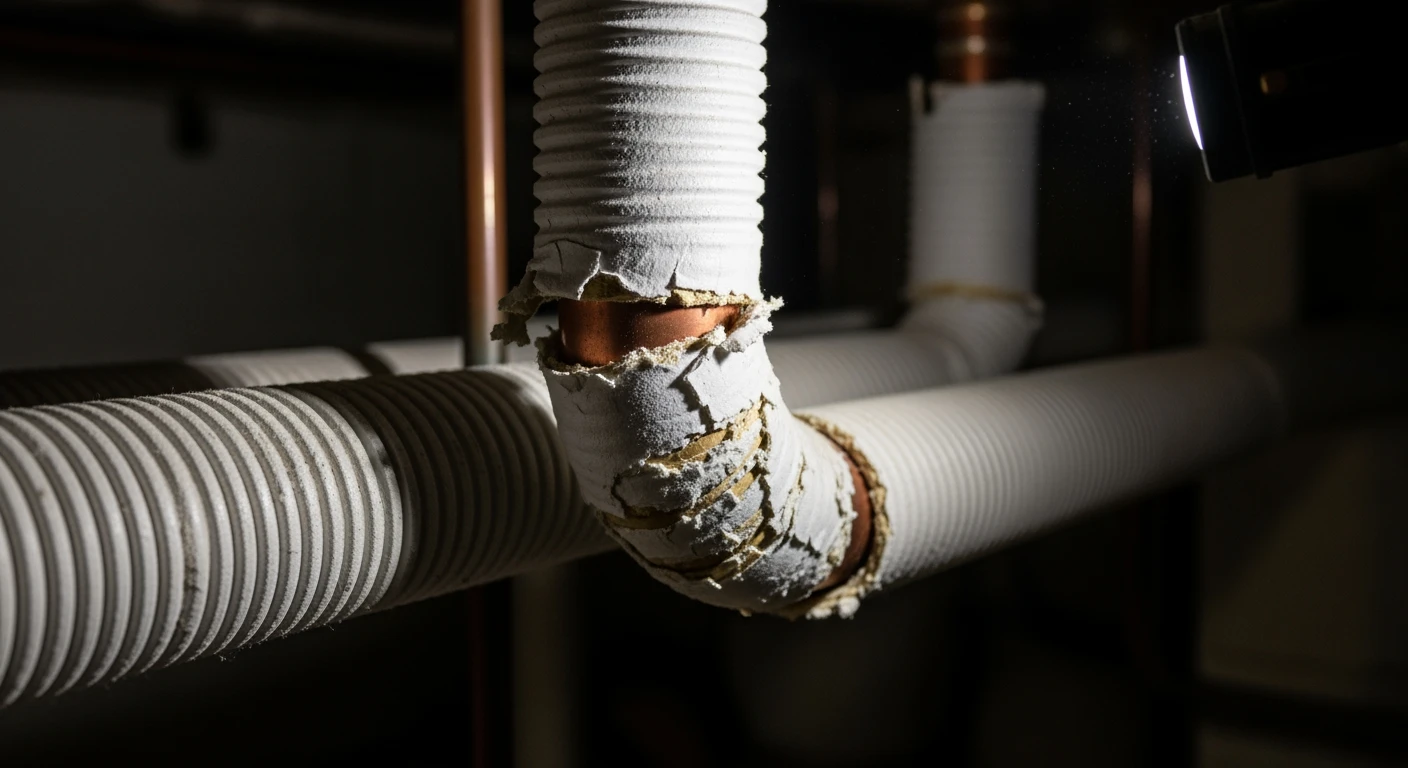
What it looks like: Corrugated air-cell pipe insulation is the single most recognizable asbestos-containing material in residential properties. It appears as a ridged, cardboard-like wrap fitted snugly around hot water and heating pipes, typically in half-shell sections clamped around the pipe. The outer surface is white or light gray, sometimes painted over, with visible corrugated ridges running perpendicular to the pipe. The material is rigid — it does not compress easily when pressed. When damaged, the interior reveals a fibrous, layered structure that may shed loose fibers.
Where to find it on Long Island: Start in your basement. Follow the hot water and heating pipes from your boiler to where they enter walls or ceilings. Corrugated pipe insulation was installed on virtually all exposed heating distribution pipes in Long Island homes built from the 1940s through the late 1970s. Pay particular attention to straight runs of 3 feet or more — these are the sections most likely to have full corrugated wrap coverage.
Risk level: HIGH when damaged. Corrugated pipe insulation is classified as friable — it crumbles easily when handled, releasing respirable asbestos fibers. Intact, undisturbed corrugated wrap poses low immediate risk. However, this material deteriorates over time from thermal cycling (the expansion and contraction of hot pipes), vibration from the heating system, and simple aging. If you see sections that are cracked, crumbling, sagging, or visibly damaged, the material is actively releasing fibers into your basement air.
Common confusion: Modern fiberglass pipe insulation is softer, compressible, usually pink or yellow, and often wrapped in a white or silver foil jacket. Asbestos corrugated wrap is rigid, dense, and the corrugation pattern is distinctive — fiberglass pipe insulation does not have corrugated ridges. Foam pipe insulation (black or gray rubber tubes) is a modern product that never contained asbestos.
Type 2: Hard-Set Plaster Asbestos Insulation — At Joints, Elbows, and Fittings
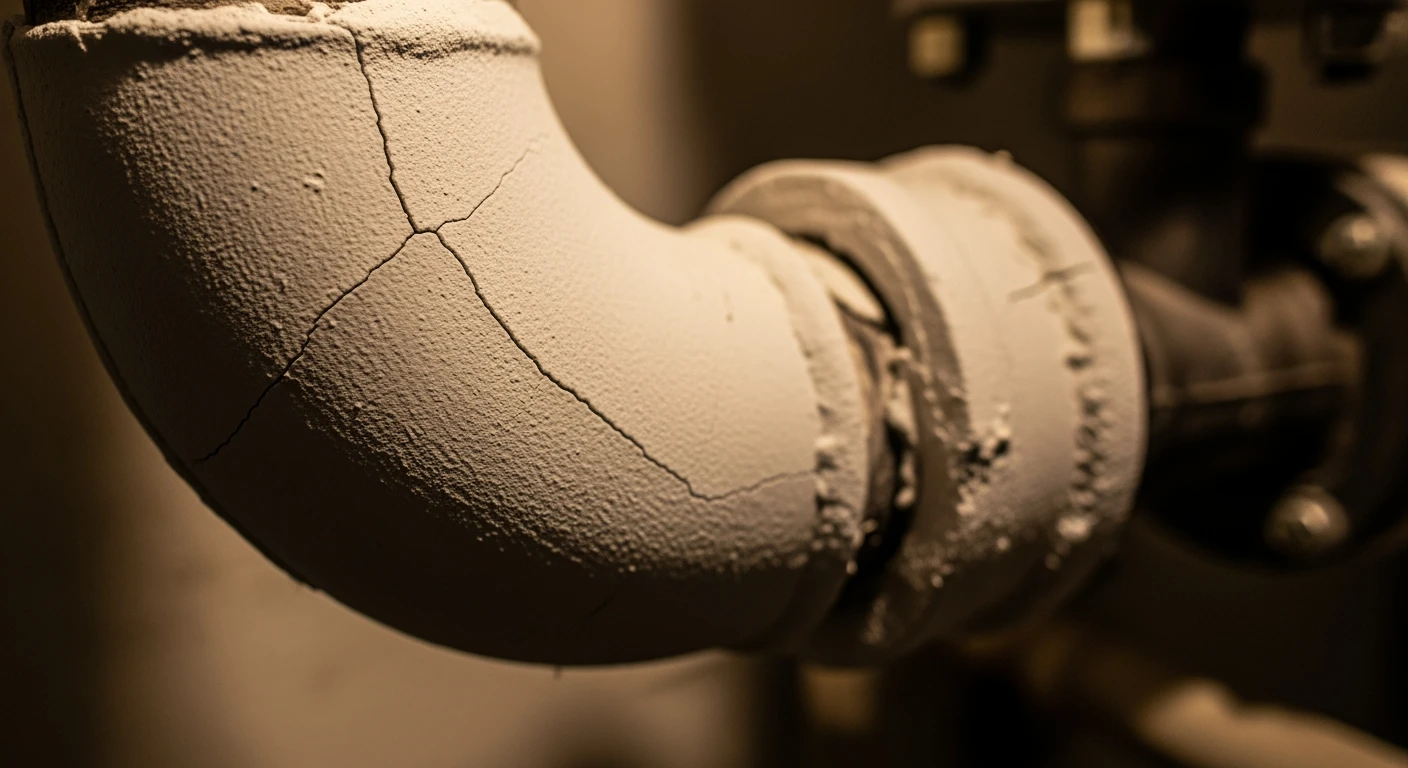
What it looks like: At pipe elbows, tees, valves, and other fittings where pre-formed corrugated sections cannot fit, installers applied a wet asbestos-cement mixture by hand that dried to a smooth, hard, plaster-like finish. The result is a white or gray coating that appears similar to drywall mud or plaster, typically 1/2 to 2 inches thick. With age, this material develops hairline cracks in a web-like pattern — the unmistakable signature of decades of thermal expansion and contraction.
Where to find it on Long Island: Look at every pipe fitting in your basement — every elbow where a pipe changes direction, every tee where a pipe branches, every valve or connection point. Even homes where straight pipe runs have been re-insulated with modern fiberglass may still have original asbestos plaster at the fittings, because these areas are labor-intensive to re-insulate and are often left in place.
Risk level: MODERATE to HIGH. Intact plaster-type insulation is less friable than corrugated wrap — the cement binder makes it more durable. However, cracked or deteriorating plaster insulation releases fibers, and any impact (accidentally hitting a pipe with a tool, bumping an elbow during storage work) can break the material and create immediate fiber release. The cracking pattern common on older installations indicates the material is becoming increasingly fragile.
Why this matters during renovation: Many Long Island homeowners renovate basements without realizing the plaster material at pipe fittings contains asbestos. A plumber replacing a valve, an HVAC technician modifying ductwork, or a general contractor framing a wall near pipe runs can all disturb this material. Any work near plaster-coated pipe fittings in a pre-1980 home should be preceded by testing.
Type 3: Vermiculite Attic Insulation — The Hidden Risk from Libby, Montana
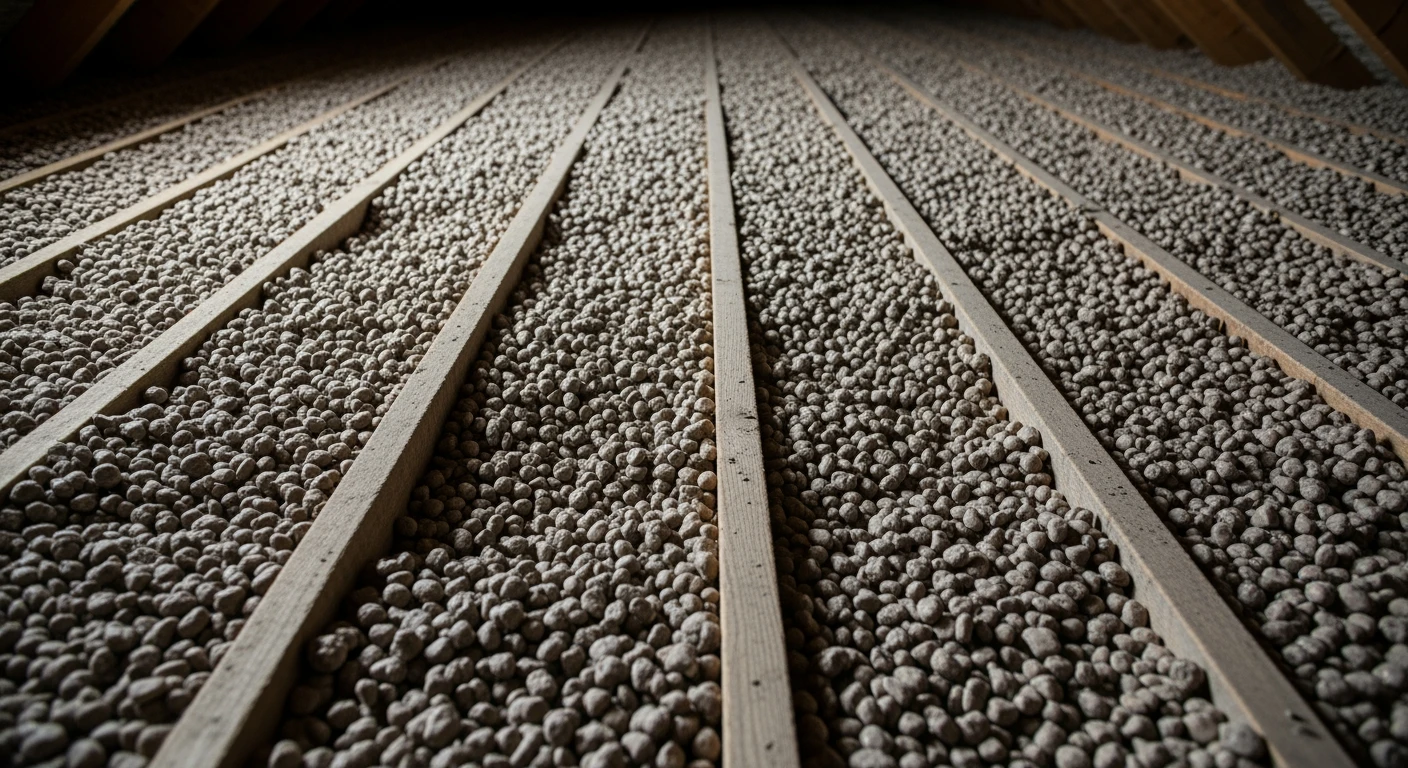
What it looks like: Vermiculite attic insulation appears as small, lightweight, pebble-like granules poured loosely between attic joists. The granules are gray-brown, silver-gold, or tan, and each one has a distinctive accordion or worm-like shape — compressed, layered flakes that expand when heated (which is how vermiculite is processed). A single granule is typically 1/4 to 1/2 inch in size. The overall appearance is a loose, granular fill — not batts, not blown cellulose, not fiberglass. It looks like nothing else.
The Libby, Montana connection: Vermiculite itself is a naturally occurring mineral that does not inherently contain asbestos. However, the world’s largest vermiculite mine — operated by W.R. Grace and Company in Libby, Montana — was contaminated with naturally occurring tremolite asbestos. This mine produced approximately 70% of the vermiculite sold in the United States from the 1920s through 1990, marketed under the brand name Zonolite. If your attic has vermiculite insulation and it was installed before 1990, the EPA recommends assuming it may contain asbestos and not disturbing it without professional guidance.
Where to find it on Long Island: Attics, primarily. Pull down your attic access hatch and look between the joists. Vermiculite was poured in as loose fill, typically to a depth of 4 to 8 inches. Some Long Island homes also have vermiculite in wall cavities (blown in through holes drilled in the exterior), though this is less common than attic application.
Risk level: MODERATE when undisturbed, HIGH when disturbed. Vermiculite sitting in your attic between joists is relatively stable — the asbestos fibers are mixed within the mineral matrix. The risk increases dramatically when vermiculite is disturbed: walking through the attic, storing boxes on it, adding new insulation on top, or removing it for renovation all generate dust that may contain asbestos fibers. The EPA specifically advises homeowners not to disturb vermiculite insulation and not to use the attic for storage if vermiculite is present.
Common confusion: Vermiculite looks nothing like fiberglass (pink/yellow fluffy batts), cellulose (gray shredded paper), or blown mineral wool (gray-white cottony tufts). The accordion-shaped granules are distinctive. However, some homeowners confuse perlite (white, round, Styrofoam-like beads) with vermiculite — perlite does not contain asbestos.
Type 4: Boiler and Furnace Insulation — The Thick Coating on Heating Equipment
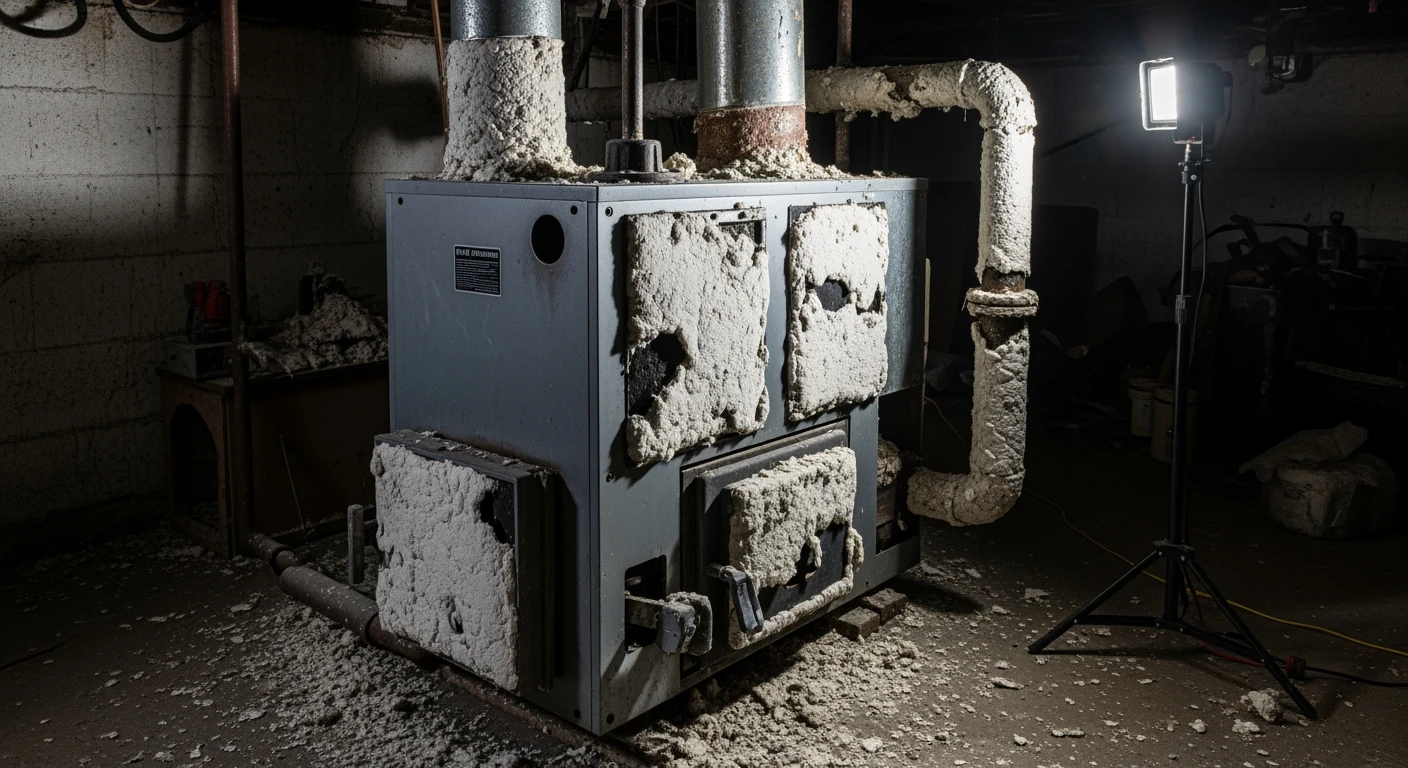
What it looks like: Older residential boilers and furnaces were insulated with a thick asbestos-cement blanket or coating applied directly to the equipment body and often extending onto the first several feet of connected piping. The material appears as a white, gray, or tan coating, typically 1 to 3 inches thick, with a rough or slightly textured surface. On aging equipment, this coating may show significant deterioration: crumbling edges, missing sections exposing bare metal, dust accumulation at the base of the unit, and visible fiber strands at damaged areas.
Where to find it on Long Island: If your Long Island home still has its original boiler or furnace from the 1940s through the mid-1970s, the equipment almost certainly has asbestos insulation. Look at the boiler body, the combustion chamber door gasket, the flue pipe connection, and the first few feet of all distribution pipes leaving the unit. Even homes that have replaced their boiler may have asbestos insulation remaining on the original piping that was not removed during the equipment swap.
Risk level: HIGH when deteriorating. Boiler insulation is subject to constant thermal cycling — the boiler heats up and cools down with every firing cycle, and this repeated expansion and contraction gradually breaks down the insulation matrix. Boilers that run hard during Long Island winters experience thousands of thermal cycles over their lifespan. Deteriorating boiler insulation deposits asbestos dust on the basement floor, in the air around the equipment, and on anything stored nearby.
Quick Visual Comparison: Asbestos Insulation vs. Safe Modern Alternatives
| Material | Appearance | Contains Asbestos? |
|---|---|---|
| Corrugated pipe wrap | Rigid, ridged white/gray wrap on pipes | Very likely if pre-1980 |
| Plaster coating at fittings | Smooth cement-like white/gray coating at joints | Very likely if pre-1980 |
| Vermiculite granules | Small accordion-shaped gray-brown pebbles | Likely (70% from contaminated source) |
| Boiler/furnace coating | Thick white-gray wrap on heating equipment | Very likely if pre-1980 |
| Fiberglass batts | Pink/yellow fluffy cotton-candy texture | No |
| Cellulose (blown) | Gray shredded paper, cottony | No |
| Foam pipe insulation | Black/gray rubber tubes, flexible | No |
| Fiberglass pipe wrap | Yellow/pink with foil jacket, soft | No |
Where to Check in Your Long Island Home — A Room-by-Room Walkthrough
Basement (highest priority). Start at the boiler. Look at the equipment body, the flue connection, and every pipe leaving the unit. Follow the heating distribution pipes across the basement ceiling, checking both straight runs (corrugated wrap) and every elbow, tee, and valve (plaster coating). Check hot water heater pipes. Look at any cloth-wrapped or paper-backed insulation on pipes entering walls.
Attic. Pull down the access hatch and look between the joists from the opening — do not walk into the attic if you see granular material. If you see the distinctive accordion-shaped granules of vermiculite, do not disturb it. If you see pink fiberglass batts or gray cellulose, those materials do not contain asbestos.
Crawl spaces. If your Long Island home has a crawl space, pipe insulation in this area is often the most deteriorated because crawl spaces experience moisture, temperature extremes, and pest activity that accelerate insulation breakdown.
Utility closets and mechanical rooms. Furnace rooms, water heater closets, and utility areas may contain insulated pipes or equipment with asbestos-containing materials.
What to Do When You Find Suspect Insulation
Step 1: Do not touch or disturb it. Leave the area. Do not attempt to remove, repair, or cover the material yourself. Do not sweep, vacuum, or clean up any debris from deteriorating insulation with a household vacuum — ordinary vacuums blow asbestos fibers through the exhaust and spread contamination.
Step 2: Assess the condition. From a safe distance (without touching), determine whether the insulation is intact and in good condition, or damaged and deteriorating. Intact material in a low-traffic area is a lower priority than crumbling material in a space you use regularly.
Step 3: Have it tested. Hire a NYS DOH-certified asbestos inspector to collect bulk samples and submit them to a NVLAP-accredited laboratory. On Long Island, residential insulation testing typically costs $200 to $600 depending on the number of materials sampled. Results return in 3 to 5 business days.
Step 4: Decide on management or removal. If the insulation tests positive for asbestos and is in good condition, it can be safely managed in place — documented, monitored periodically, and left alone until renovation requires disturbance. If it is deteriorating or will be disturbed by planned work, engage a NYS DOL-licensed asbestos abatement contractor for professional removal under containment with air monitoring.
The Bottom Line for Long Island Homeowners
Asbestos insulation is not one thing — it is at least four different materials in four different locations, each with its own appearance and risk profile. The corrugated pipe wrap in your basement, the plaster at your pipe fittings, the vermiculite in your attic, and the coating on your boiler all require recognition and respect. None of them are immediately dangerous when intact and undisturbed. All of them become serious hazards when damaged, deteriorated, or disturbed without proper precautions.
The single most important action you can take is knowing what exists in your home before you start any renovation, maintenance, or improvement project that could disturb these materials.
Upper Restoration’s Insulation Abatement Services on Long Island
Upper Restoration provides licensed asbestos insulation removal across Long Island — from pipe insulation abatement in residential basements to full mechanical system stripping in commercial buildings. Our NYS DOL-licensed crews handle every form of asbestos insulation identified in this guide, including the notoriously difficult boiler and fitting work that requires precision to avoid unnecessary fiber release. We coordinate with certified inspectors for testing and deliver clearance documentation that confirms your home is safe. Serving Nassau and Suffolk Counties.
Frequently Asked Questions: Identifying Asbestos Insulation
What does asbestos pipe insulation look like?
Asbestos pipe insulation appears as white or gray material wrapped around heating and plumbing pipes. The most recognizable form is corrugated air-cell wrap — a ridged, cardboard-like covering that fits snugly around pipes. Other forms include smooth plaster-like coatings at joints and elbows, and cloth-wrapped blanket insulation. All forms were common in Long Island homes built between 1940 and 1980.
What does asbestos insulation look like in walls?
Asbestos wall insulation is rare compared to pipe insulation, but some Long Island homes have asbestos-containing batt insulation or loose-fill insulation in wall cavities. It may appear as gray or white fibrous material, sometimes with a paper or foil backing. Vermiculite loose-fill — small accordion-shaped granules — was also used in some wall cavities and may contain asbestos from the Libby, Montana mine.
What does asbestos attic insulation look like?
The most common asbestos-containing attic insulation is vermiculite — small, lightweight, pebble-like granules in gray-brown, silver-gold, or tan colors poured loosely between attic joists. Individual granules have a distinctive accordion or worm-like shape. Approximately 70% of U.S. vermiculite came from a mine contaminated with tremolite asbestos.
How can I tell the difference between asbestos insulation and fiberglass?
Fiberglass insulation is typically pink, yellow, or white and has a fluffy, cotton-candy-like texture that is clearly fibrous to the naked eye. Asbestos pipe insulation is denser, more rigid, and often has a corrugated, plaster-like, or cloth-wrapped appearance. However, visual identification alone cannot confirm asbestos — only laboratory testing can determine asbestos content definitively.
Is it safe to touch asbestos insulation?
Do not touch, disturb, or attempt to remove suspect insulation. Intact asbestos insulation that is undisturbed poses minimal airborne risk. However, touching friable asbestos pipe insulation can release microscopic fibers. If you need to work near suspect insulation, hire a NYS DOH-certified inspector to test it first.
What should I do if I find asbestos insulation in my Long Island home?
Do not disturb it. If the insulation is intact and in good condition, it can safely remain in place with periodic monitoring. If it is damaged, deteriorating, or will be disturbed by renovation, hire a NYS DOH-certified inspector to collect samples for testing. If confirmed positive, a NYS DOL-licensed abatement contractor must perform any removal.
