New York’s industrial heritage left behind warehouses, factories, and manufacturing plants across Long Island and the greater New York metropolitan area filled with industrial-grade asbestos materials far more extensive than what is found in typical commercial office buildings. From boiler insulation rated for extreme temperatures to spray-applied fireproofing on massive structural steel, industrial asbestos removal demands specialized capabilities and a thorough understanding of both New York State regulations and OSHA industrial safety requirements.
Asbestos Materials Common in Industrial Facilities
Boiler and vessel insulation. Industrial boilers, pressure vessels, and heat exchangers used thick asbestos insulation rated for temperatures exceeding 500°F. This insulation — often several inches thick — contains high concentrations of chrysotile and amosite asbestos. Long Island’s industrial facilities along the Route 110 corridor, in Hicksville, and throughout western Suffolk County commonly contain this material.
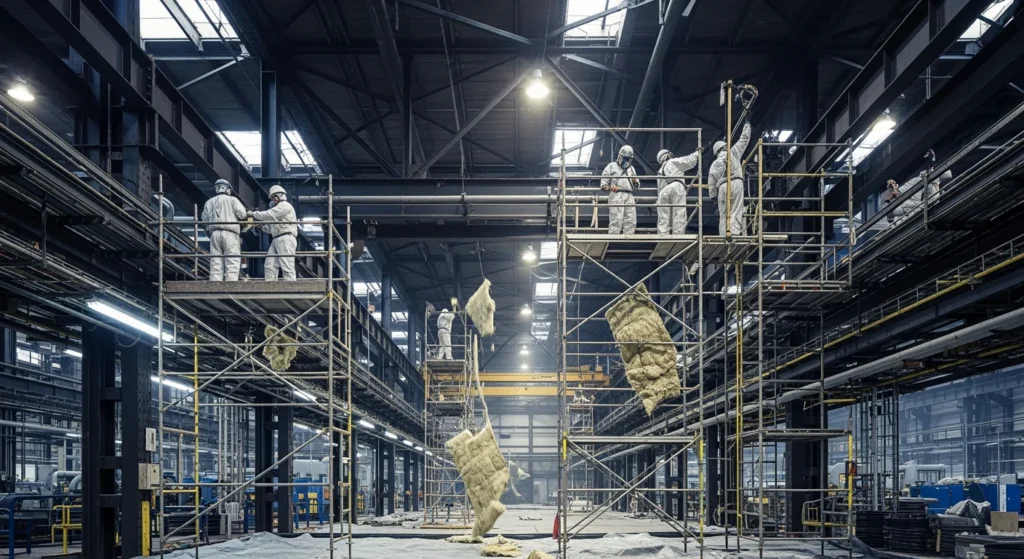
Spray-applied fireproofing on structural steel. Warehouses and factories with exposed structural steel frequently received spray-applied asbestos fireproofing during construction. This friable material covers large surface areas at heights that require scaffolding or aerial lifts for removal.
Transite panels and cement board. Asbestos-cement panels (brand name Transite) were used for exterior siding, interior partitions, laboratory hoods, and equipment enclosures in industrial settings. While non-friable when intact, cutting or breaking these panels releases concentrated asbestos fibers.
Gaskets, packing, and refractory materials. Industrial equipment — valves, pumps, ovens, kilns — used asbestos gaskets, rope packing, and refractory cement extensively. These materials are encountered during equipment decommissioning and must be removed by licensed abatement workers.
Roofing and flashing. Industrial flat roofs frequently used asbestos-containing built-up roofing, flashing cement, and roof coatings. Roof removal or re-roofing triggers asbestos abatement requirements.
Challenges Specific to Industrial Abatement
Scale. Industrial buildings contain asbestos quantities measured in tons rather than pounds. A single warehouse may have 10,000+ linear feet of insulated piping and 50,000+ square feet of spray-applied fireproofing. Project planning, waste disposal logistics, and cost all scale accordingly.
Height and access. Industrial facilities with 30-60 foot clear heights require scaffolding systems, aerial work platforms, or suspended containment methods that add significant cost and safety complexity.
Confined spaces. Boiler interiors, ductwork, tanks, and tunnels in industrial facilities contain asbestos and require confined space entry protocols per OSHA 29 CFR 1910.146, adding another layer of safety requirements to the abatement work.
Phased operations. When industrial operations must continue during abatement, projects are phased to isolate work areas while maintaining production. This approach extends project timelines but preserves revenue for the facility owner.
Pre-Demolition Requirements for Industrial Buildings
Before any industrial building in New York can be demolished, a thorough asbestos survey must be performed by a NYS DOH-certified inspector. All friable and regulated ACMs must be removed by a licensed abatement contractor before demolition begins. EPA NESHAP requires 10-working-day advance notification for all demolitions. Failure to survey and abate before demolition carries severe penalties, including federal enforcement action and potential criminal charges.
Upper Restoration’s Industrial Abatement Capabilities
Upper Restoration provides industrial-scale asbestos abatement across Long Island and the New York metropolitan area. Our licensed crews handle high-ceiling containment, boiler room abatement, confined space entry, and phased removal programs that keep industrial operations running. We manage NYS DOL compliance, coordinate third-party air monitoring, and handle disposal logistics for large-volume industrial projects in Nassau and Suffolk Counties and beyond.