Commercial asbestos removal is one of the most consequential line items a Long Island building owner will face during renovation, demolition, or regulatory compliance work. Unlike residential projects, commercial abatement involves stricter oversight from the New York State Department of Labor (NYS DOL) and the NYC Department of Environmental Protection (DEP), and costs reflect that complexity.
What Does Commercial Asbestos Removal Cost on Long Island?
Commercial asbestos removal on Long Island ranges from $15 to $75 per square foot for most projects, though costs vary significantly based on the type of asbestos-containing material, accessibility, and building occupancy status. Here is how pricing breaks down by material type for Nassau and Suffolk County commercial properties:
Cost by Material Type
Pipe insulation removal runs $10 to $25 per linear foot. This is the most common commercial abatement task and involves removing chrysotile or amosite wrapping from HVAC and plumbing lines. Buildings constructed between 1940 and 1980 on Long Island almost universally contain asbestos pipe insulation.
Floor tile abatement averages $5 to $15 per square foot. The classic 9×9-inch vinyl asbestos tile (VAT) found in commercial buildings across Nassau and Suffolk Counties requires careful removal of both tile and mastic. Encapsulation may reduce costs to $2-$5 per square foot where regulations permit.
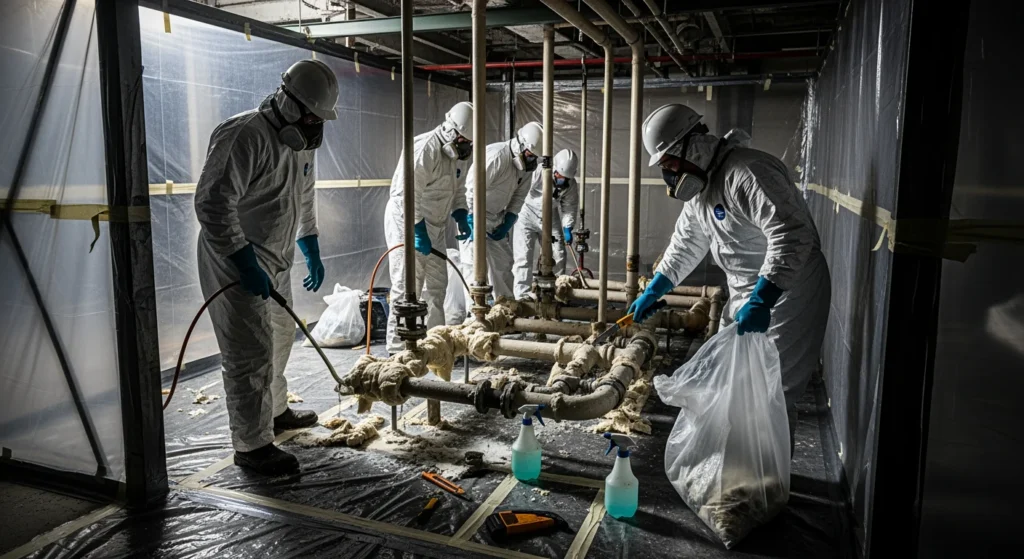
Spray-applied fireproofing removal costs $15 to $75 per square foot — the widest range and highest potential cost. Friable spray-applied asbestos in commercial high-rises and older industrial buildings on Long Island requires full negative-pressure containment, HEPA filtration, and extensive air monitoring.
Ceiling tile and acoustic material removal runs $8 to $20 per square foot. Suspended ceiling systems with asbestos-containing tiles are prevalent in Long Island office buildings, schools, and municipal structures built before 1981.
Roofing material abatement averages $5 to $15 per square foot. Asbestos-cement roofing on commercial buildings requires wet-removal methods and specialized disposal.
Factors That Drive Commercial Asbestos Removal Costs Higher
Several project-specific variables push commercial abatement costs above baseline estimates on Long Island:
Friability. Friable asbestos (material that crumbles when touched) demands full containment with negative air pressure, polyethylene sheeting, decontamination chambers, and continuous air monitoring. Non-friable materials like intact floor tiles cost less because fiber release risk is lower during removal.
Occupied building work. Removing asbestos from a building that remains partially occupied — common in Long Island office parks and retail centers — requires additional containment measures, after-hours scheduling, and enhanced air monitoring to protect tenants. This can add 30-50% to project costs.
Access difficulty. Asbestos behind walls, above drop ceilings, in mechanical chases, or in confined spaces like boiler rooms increases labor hours and containment complexity significantly.
Regulatory compliance documentation. New York State requires project notifications to the NYS DOL at least 10 days before abatement begins. Air monitoring by a third-party NYS DOH-certified asbestos air analyst is mandatory. These compliance costs add $2,000 to $10,000+ depending on project duration.
Disposal logistics. All asbestos waste from Long Island commercial projects must be transported by a licensed hauler to an approved disposal facility. Nassau and Suffolk County projects typically use licensed landfills accepting regulated asbestos-containing material (RACM). Disposal fees average $35 to $75 per cubic yard.
How to Budget for Commercial Asbestos Removal on Long Island
Smart budgeting starts before you request quotes. Building owners and property managers in Nassau and Suffolk Counties should follow this sequence:
Step 1: Commission an asbestos survey. Hire a NYS DOH-certified asbestos inspector to perform a thorough survey identifying all ACMs. This is legally required before any renovation or demolition project disturbing more than minimal quantities. Budget $1,500 to $5,000 depending on building size.
Step 2: Get the lab analysis. Bulk samples from the survey go to an accredited laboratory using Polarized Light Microscopy (PLM) or Transmission Electron Microscopy (TEM). Results typically return in 3-5 business days. Cost: $25-$50 per sample.
Step 3: Obtain three abatement bids. Request detailed proposals from NYS DOL-licensed commercial abatement contractors. Each bid should itemize costs per material, containment, air monitoring, disposal, and project management. On Long Island, expect 2-3 weeks for competitive bidding on larger projects.
Step 4: Factor in project management and oversight. Third-party air monitoring during abatement is mandatory in New York. Budget an additional 10-15% of abatement costs for this oversight, which protects you legally and confirms clearance.
Why Long Island Commercial Asbestos Costs Differ from Residential
Commercial projects carry higher per-unit costs than residential work for several reasons specific to the Long Island market. Commercial buildings have larger contiguous areas of ACMs, requiring industrial-scale containment. New York State regulatory requirements for commercial abatement exceed residential thresholds — particularly the notification requirements, licensed contractor mandates, and third-party air monitoring standards. Labor costs on Long Island reflect the prevailing wage requirements that apply to many commercial and public projects in Nassau and Suffolk Counties.
Upper Restoration’s Commercial Asbestos Abatement Services
Upper Restoration provides licensed commercial asbestos abatement across Long Island, serving building owners, property managers, general contractors, and municipal facilities throughout Nassau and Suffolk Counties. Our team handles every phase from initial survey coordination through final clearance documentation, ensuring full compliance with NYS DOL and DEP requirements while minimizing disruption to building operations.