As an IICRC-certified Odor Control Technician (OCT), I have walked into hundreds of homes where the owner thought they had “fixed” the fire damage. The walls were freshly painted in a modern eggshell finish, the carpets had been shampooed, and the soot was nowhere to be seen. Yet, the moment the HVAC system kicked on or the afternoon sun hit the living room windows, the unmistakable, acrid stench of a structure fire returned with a vengeance.
The most common mistake homeowners make following a fire is assuming that smoke damage is a cosmetic issue. It isn’t. Smoke damage is a chemical and physical intrusion into the very substrate of your home. Attempting to mask these odors with standard retail paint is like trying to put a band-aid on a deep infection; you are simply trapping the problem beneath a thin layer of film, where it will wait for the right atmospheric conditions to re-emerge. To achieve permanent smoke odor removal techniques, one must understand the microscopic behavior of smoke and the advanced molecular neutralizers required to combat it.
The Physics of Smoke Particles
To understand why smoke is so difficult to remove, we must look at it through a microscope. Smoke is a byproduct of incomplete combustion, consisting of solid particles, liquid aerosols, and gases. In a typical house fire, these particles range in size from 0.1 to 4 microns. To put that in perspective, a human hair is approximately 70 microns wide. These particles are small enough to penetrate almost any porous material found in a residential structure.
Furthermore, fire involves extreme heat. In physics, we know that heat causes materials to expand. When a fire rages, the pores in your wooden framing, your drywall, and even your concrete expand. This creates a “vacuum effect” where the pressurized smoke is driven deep into the interior of these materials. As the fire is extinguished and the house cools, those pores contract, effectively “locking” the smoke particles and charred resins inside the walls.
This is why simple surface cleaning or painting fails. The odor is not just *on* the wall; it is *in* the wall. This leads to a phenomenon known as “off-gassing.” When the temperature or humidity in your home rises, the materials expand again, releasing those trapped microscopic particles back into the air. This is why the smell often returns during the summer months or when the heater is running.
Why Cleaning is Only Step One
Professional restoration follows the IICRC S700 Standard for Professional Fire and Smoke Damage Restoration. This standard dictates that the first step is always the removal of the source. This means physically cleaning the soot and char from every surface. However, cleaning is merely the prerequisite for deodorization.
Soot is often acidic. If left on surfaces, it can cause “pitting” in glass and permanent staining on plastics and stone. We use specialized dry chemical sponges and HEPA-vacuuming to remove the bulk of the particulate matter. But even after a surface looks clean, the molecular “ghost” of the fire remains. If you skip the professional deodorization phase and jump straight to painting, you are creating a “smoke sandwich.” The paint will initially seal the odor, but because the smoke particles are often oily (especially in kitchen fires), the paint may fail to bond correctly, leading to peeling, bubbling, and the eventual migration of the odor through the paint film.
Effective smoke odor removal techniques require a multi-phased approach that addresses the air, the surfaces, and the internal pores of the building materials.
Advanced Technology: Ozone vs. Hydroxyl
When professional restorers talk about “breaking down” odors, we are usually referring to oxidation. We use industrial-grade equipment to change the chemical structure of the odor molecules so they no longer register as “smell” to the human nose. Two of the most effective tools in our arsenal are Ozone and Hydroxyl generators.
Ozone Generators (O3)
Ozone is an unstable gas consisting of three oxygen atoms. Because it is highly reactive, it seeks out organic odor molecules and oxidizes them on contact. It is incredibly fast and effective for heavy “protein” fires (like burnt meat) or deep wood char. However, Ozone is a respiratory irritant. During an Ozone treatment, the home must be completely vacated—no people, no pets, and no indoor plants. It can also degrade certain rubbers and elastic materials if left running for too long.
Hydroxyl Generators (OH)
Hydroxyl radicals are the “detergent” of the atmosphere. In nature, they are created by the sun’s UV rays reacting with moisture in the air. Industrial hydroxyl generators mimic this process. Unlike Ozone, Hydroxyls are safe for occupied spaces. While they work more slowly than Ozone, they are often the preferred choice for homeowners who cannot vacate their property or for environments containing sensitive materials like fine art or high-end electronics.
| Method | Occupancy Safe? | Action Mechanism | Speed |
|---|---|---|---|
| Ozone Generator | NO (Must vacate) | Oxidizes molecules | Fast (24-48 hrs) |
| Hydroxyl Generator | YES | Uses UV sun technology | Slower (3-5 days) |
| Thermal Fogging | NO (Briefly) | Pairs deodorizer with heat | Immediate impact |
| Sealing/Painting | YES | Traps odor (only if cleaned first) | Instant |
Our team at Upper Restoration owns a fleet of industrial Ozone and Hydroxyl equipment, allowing us to choose the exact tool for your specific fire profile. We don’t just “freshen” the air; we chemically dismantle the smoke.
The Role of Thermal Fogging
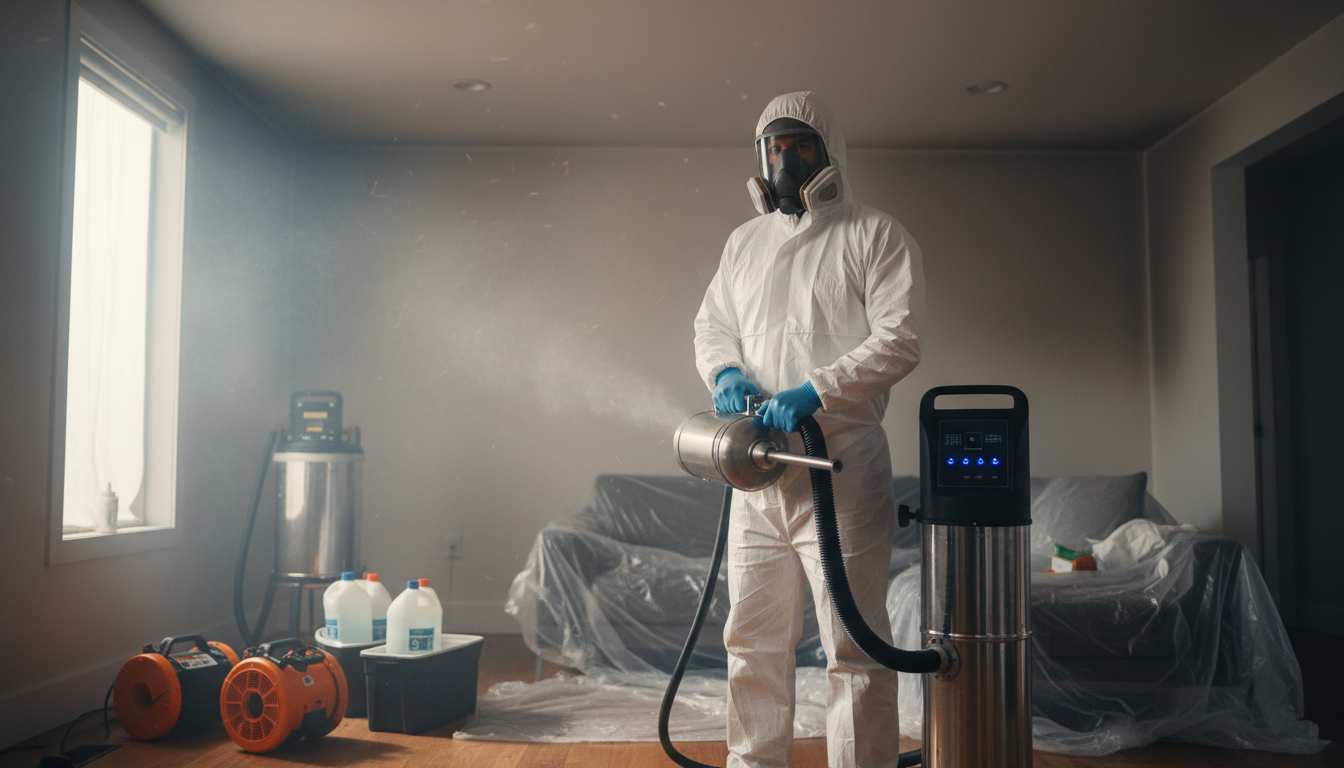
If Ozone and Hydroxyls are the “chemical” solutions, Thermal Fogging is the “physical” mimic. As we discussed earlier, smoke entered your walls because it was hot and pressurized. Thermal fogging works on the same principle.
We use a specialized machine to heat a petroleum- or solvent-based deodorizer and turn it into a dense fog. The particle size of this fog is nearly identical to that of the original smoke (0.5 to 2 microns). Because the fog is hot, it mimics the behavior of the fire’s smoke, following the exact same pathways into the pores of the wood and drywall. Once inside, the deodorizer pairs with the smoke molecules and neutralizes them. This is often the “missing link” in dealing with smoke and odor removal.
The Role of Encapsulation
Only after the air has been scrubbed, the surfaces cleaned, and the structure fogged or oxidized should we discuss paint. In the restoration industry, we call this “encapsulation.”
You cannot use standard latex house paint to seal smoke. You must use a specialized smoke-sealing primer, typically shellac-based or high-solids oil-based (such as BIN or Kilz Restoration). These primers are designed to create a vapor-tight barrier that prevents any remaining microscopic particles from off-gassing. When we perform a “Guaranteed Odor Removal” service, encapsulation is the final seal on a comprehensive scientific process.
Why Professional Intervention is Essential
Many homeowners attempt the “DIY route” to save money, only to find that they have to pay double later when the smell returns and they have to strip the paint they just applied. A professional restoration company doesn’t just bring “better soap”; we bring a deep understanding of thermodynamics, chemistry, and building science. Following the IICRC S700 standards ensures that the job is done right the first time, protecting both your health and your property value.
Frequently Asked Questions
Q: Why does the smoke smell come back on hot days?
A: This is due to “off-gassing.” Heat causes the pores of wood, drywall, and upholstery to expand. When they expand, they release the smoke particles that were trapped deep inside during the fire. Professional deodorization must happen *before* you seal the surfaces to prevent this.
Q: Can I just use a charcoal air filter?
A: While activated carbon filters can help remove some VOCs from the air, they do nothing to address the odor molecules trapped inside your walls and attic insulation. They are a temporary fix for a permanent problem.
Q: Is the smell of Ozone dangerous?
A: Yes, in high concentrations. Ozone is a powerful oxidant. This is why we insist that homes be vacant during treatment. After the treatment is complete, we ventilate the home, and the O3 quickly reverts back to O2 (standard oxygen), leaving no toxic residue behind.
Eliminate Smoke Odors for Good
If you are struggling with a persistent smoke smell following a fire, don’t reach for the paintbrush yet. You need a solution that addresses the problem at the molecular level. At Upper Restoration, we combine IICRC-certified expertise with industrial-grade technology to provide a Guaranteed Odor Removal promise. We don’t just hide the damage; we erase it.