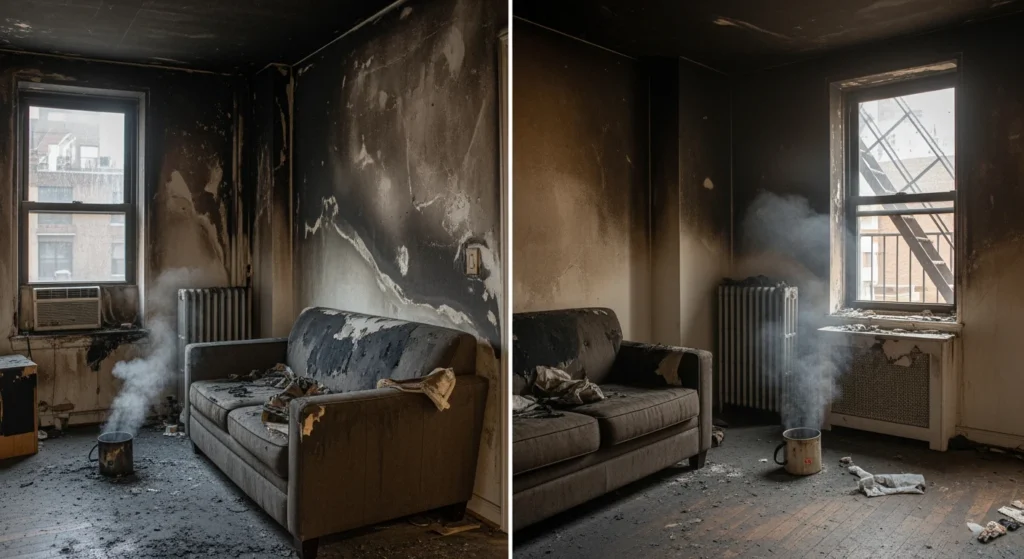
You had a small fire. Maybe it was a grease fire on the stove or an appliance that shorted out. You reacted quickly, used a fire extinguisher, and the fire was out in minutes. The flames were contained to one room, and it seems like the danger is over.
Then you notice the smell. And the fine layer of soot on everything, even in rooms far from the fire.
For current pricing information, see our detailed guide to fire damage restoration cost on Long Island.
This is the hidden danger of any fire, no matter the size. A small fire can cause extensive, big-time smoke damage. Here’s how it happens and why professional smoke damage cleanup is essential.
How Smoke Travels: The HVAC “Superhighway”
Smoke particles are microscopic, and they don’t just stay in one room. They travel on thermal currents, and the most powerful “superhighway” in your home is your HVAC system.
When a fire starts, it creates heat. This heat causes the air to rise and expand, pushing the smoke particles throughout the house. If your heating or air conditioning was running, it actively pulled the smoke and soot into the return vents and then blasted it out of every single supply vent in your home.
This is how a small kitchen fire results in soot settling on walls in an upstairs bedroom, inside closets, and deep within your ductwork.
The Problem with Soot and Odor
Smoke isn’t just a smell; it’s a physical, toxic substance.
- Soot is Acidic: Soot is the carbon-based residue of incomplete combustion. It’s oily, sticky, and acidic. When it lands on surfaces like metal (appliances, doorknobs), plastic (electronics), or stone (countertops), it begins to corrode, etch, and stain them. This damage is often irreversible if not cleaned properly and quickly.
- Odor is Pervasive: Smoke odor isn’t just in the air. It’s a gas that gets absorbed into every porous surface in your home: drywall, unfinished wood, carpeting, upholstery, and clothing. You can’t just “air out” the smell. It’s physically embedded in your home’s structure and contents.
Why DIY Cleaning Often Fails (And Makes it Worse)
Your first instinct is to grab a sponge and start scrubbing the walls. This is often the worst thing you can do.
- Smearing: Most soot is oily. Wiping it with a wet cloth or an all-purpose cleaner will just smear the soot, driving it deeper into the paint or drywall.
- Wrong Cleaners: Different types of smoke (e.g., a “wet” smoke from plastic burning vs. a “dry” smoke from wood) require completely different cleaning agents.
- Hidden Damage: You can’t clean what you can’t see. The real problem is the soot and odor inside your walls, your attic insulation, and your HVAC system.
The Professional Smoke Damage Cleanup Process
Professional smoke remediation is a comprehensive process that goes far beyond a simple surface cleaning.
- Soot Removal: Technicians use special “dry chemical sponges” to safely lift soot from drywall and other delicate surfaces without smearing it.
- Deep Cleaning: All surfaces are treated with specialized cleaning solutions designed to neutralize the specific type of soot.
- HVAC & Duct Cleaning: The entire HVAC system and all ductwork must be professionally cleaned with high-powered vacuums and agitation tools to remove all traces of soot. This is non-negotiable.
- Odor Removal (Deodorization): To permanently remove the smell, professionals use advanced techniques like thermal fogging (which heats a deodorizer to create a “fog” that follows the same path as the smoke) or ozone generation to find and neutralize the microscopic odor particles.
- Sealing and Repainting: After cleaning, walls and ceilings are often sealed with a special odor-blocking primer before repainting. This ensures any final, trapped-in odor cannot escape.
Upper Restoration provides professional fire and smoke damage restoration services across Nassau County, Suffolk County, and all five NYC boroughs — available 24/7.
Even a minor fire can leave your home with a major smoke problem. If you see or smell smoke damage after a fire, don’t try to clean it yourself. Call a certified fire and smoke restoration professional to assess the hidden damage and create a plan to get your home truly clean and safe again.